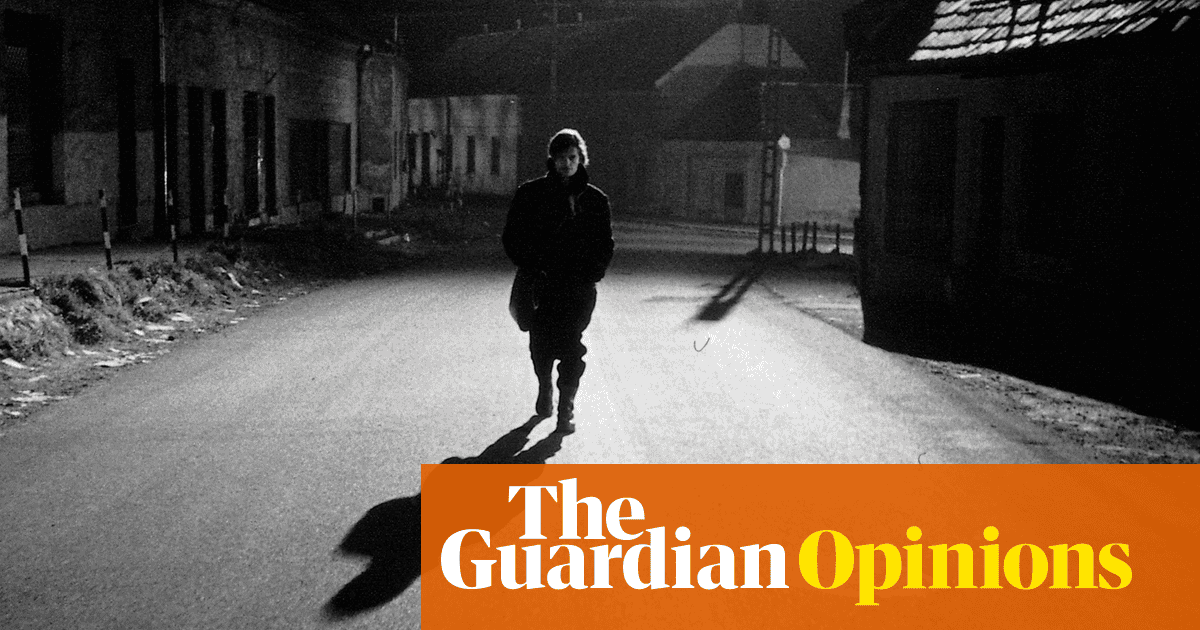
"The semi-official genre of slow cinema has been around for decades: glacial pacing, unhurried and unbroken takes, static shooting positions, characters who appear to be looking often wordlessly and unsmilingly at people or things off camera or into the lens itself, mimicking the camera's own calmly relentless gaze, the immobile silence accumulating into a transcendental simplicity. Robert Bresson, Theo Angelopoulos, Joe Weerasethakul, Lav Diaz, Lisandro Alonso; these are all great slow cinema practitioners."
"But surely no film-maker ever got the speedometer needle further back to the left than the tragicomic master Bela Tarr; his pace was less than zero, a kind of intense and monolithic slowness, an uber-slowness, in films that moved, often almost infinitesimally, like vast gothic aircraft-carrier-sized ships across dark seas. Audience reactions were often a kind of delirium or incredulity at just how punishing the anti-pace was, but given sufficient investment of attention you found yourself responding with awe, but also laughing along to the macabre dark comedy, the parable and the satire."
"A Bela Tarr movie gave you drunkenness and hangover at the same time. And people were often to be found getting despairingly drunk in his films. Tarr was like a cinematic Gogol, often working with co-director and editor Agnes Hranitzky. And yet however bleak the vision, with all its squalor and wretchedness, in person Tarr was witty in an exuberant yet somehow deadpan way, droll and wisecracking, fiercely engaged with the world, unstinting in his criticism of the intellectual mediocrity of the far right in his native Hungary and elsewhere."
Bela Tarr exemplifies an extreme form of slow cinema defined by glacial pacing, unbroken long takes, static framing, and characters who gaze wordlessly, creating an accumulating immobile silence and a transcendental simplicity. His work achieves an intense, monolithic slowness that often moves almost infinitesimally, provoking reactions of delirium, incredulity, awe, and dark laughter at macabre comedy, parable and satire. His films depict squalor and wretchedness while combining bleak vision with mordant wit. Tarr frequently collaborated with co-director and editor Agnes Hranitzky. He stepped back from filmmaking in 2011 and teaches at a Sarajevo film school, energized by working with young filmmakers.
Read at www.theguardian.com
Unable to calculate read time
Collection
[
|
...
]