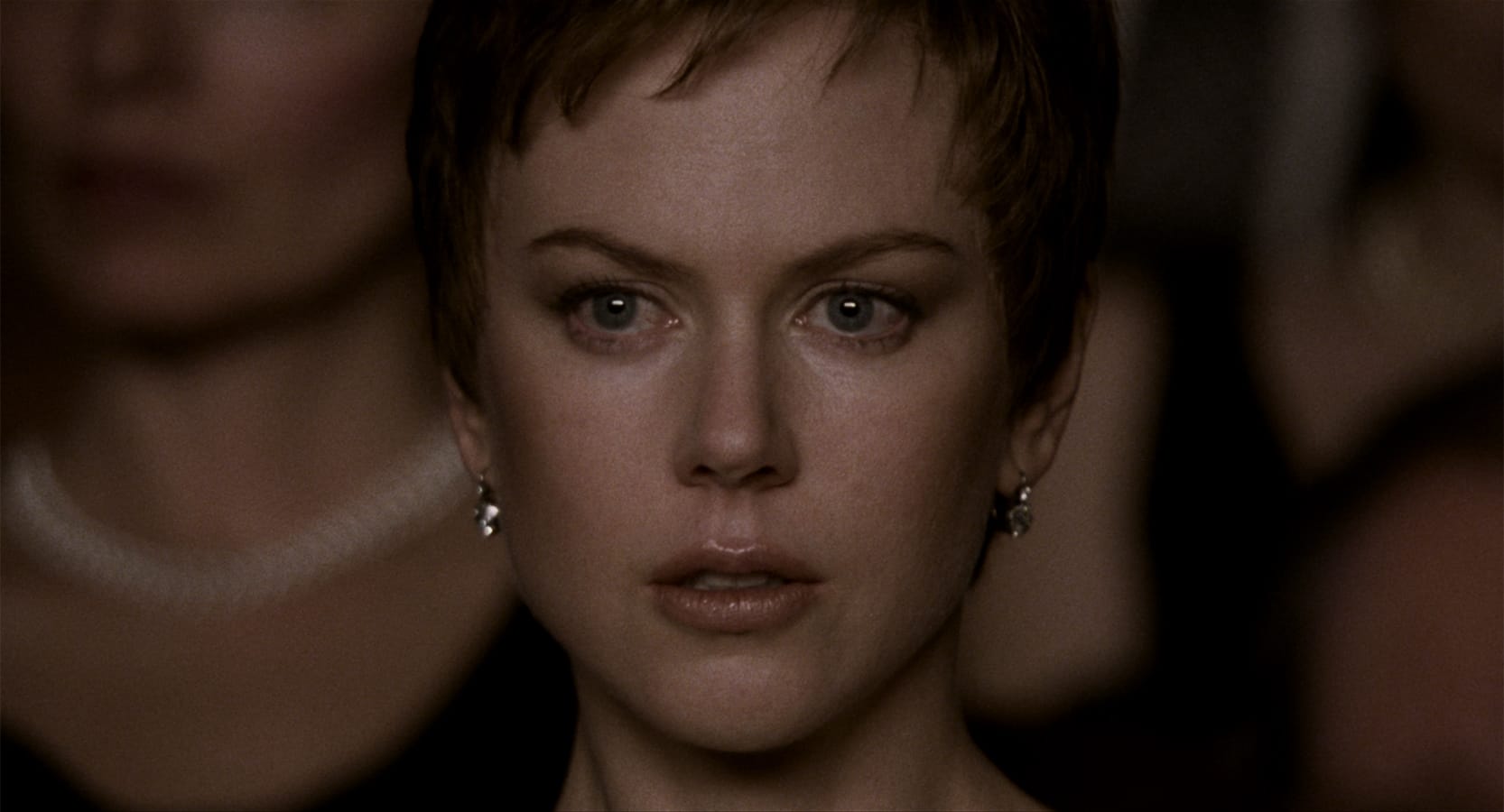
"Anna has grieved, though perhaps she's not moved on entirely, and now, after a reasonable amount of time, a modest amount of time, finds herself engaged to Joseph ( Danny Huston). Joseph, who loves her, who means well, solid/stolid Joseph, who is adequate in every way, but after all, is not Sean. No one could be Sean. There was only one Sean."
"In extreme close-up, now we'll watch just her face for the next two minutes as she silently plays out her personal drama against the backdrop of impossible ideas drawing her in like deep water seduces a diver running out of air. It's a performance worthy of Falconetti's "Passion of Joan of Arc" (Dreyer, 1929). Old money Anna. Beautiful, fragile Anna. Ferocious, broken Anna, making peace with eternity before a ritualized event enacting a sacred score."
"Anna is watching Wagner's "Götterdämmerung"twenty-seven minutes into Jonathan Glazer's " Birth" (2004)-an epic opera that, at its heart, is about a love between two people that surpasses every attempt, mortal or supernatural, to tear them apart. That's what "Birth" is about, too. Glazer seems to have an intimate understanding of the "Götterdämmerung" and its implications for mortals. A good argument can be made that the long opening of Glazer's " Under the Skin " (2013) is set to the cadences."
Anna mourns a husband who died running in Central Park; his final lesson concerned reincarnation and the limits of belief. She has grieved but becomes engaged to Joseph, a solid, well-meaning man who cannot replace Sean. Anna alternates between inward mourning and outward ritual, performing a private drama against an atmosphere of sublime, operatic ideas. The film explicitly places Wagner's Götterdämmerung within its narrative, linking the central love to mythic, apocalyptic cadences. The director aligns human attachment with Wagnerian climaxes to suggest a love that resists both mortal and supernatural attempts to dissolve it.
Read at Roger Ebert
Unable to calculate read time
Collection
[
|
...
]