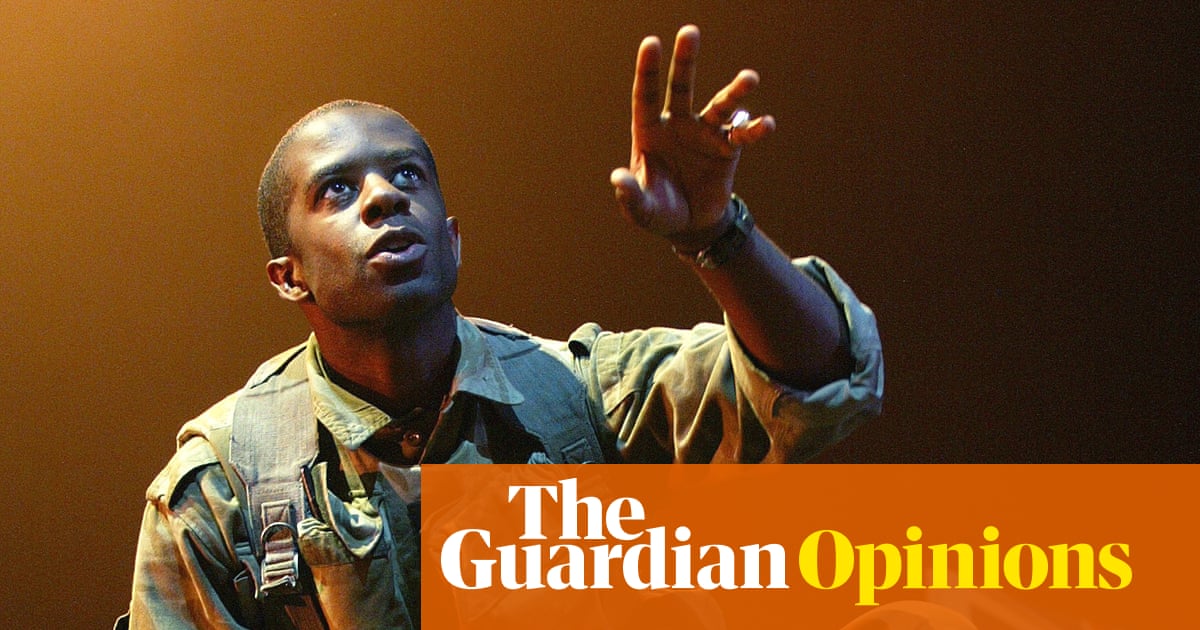
"I have long argued that Shakespeare's history plays have more urgent relevance today than his tragedies. The issues they raise such as the nature of good governance and the difficulty of deposing a tyrant are precisely those that still haunt us. Henry V, shortly to be given a new RSC production directed by Tamara Harvey, seems especially timely as we are living in a world where the threat of war is painfully real. It is also a play that constantly changes its meaning."
"James Shapiro wrote in the Guardian in 2008: There's no better way to know which way the cultural and political winds are blowing than by going to see a performance of Henry V. He reminded us that in 1599, when the play was first performed, playgoers anxiously waited to hear whether an Irish uprising had been suppressed. Two major film versions have a wildly different emphasis."
"Laurence Olivier's 1944 movie was dedicated To the Commandos of England and seen as a major contribution to the war effort. Kenneth Branagh's 1989 film, in contrast, was haunted by the spectre of Vietnam and substituted grey and muddy brown for Olivier's heightened colours. Ambiguous Kenneth Branagh, centre, in his film of Henry V. Photograph: Allstar Picture Library Ltd/Alamy Henry V, in short, is a slippery, ambiguous work that has a chameleon-like quality. Looking back over past productions, I also notice how it subtly changes depending on whether it is played in isolation or presented as part of a sequence."
Shakespeare's history plays foreground enduring questions about good governance, the difficulty of deposing tyrants, and the causes and conduct of war, offering urgent contemporary relevance. Henry V feels particularly timely when the threat of war is tangible, and the play's political valence shifts with historical context and staging decisions. Productions have reflected national moods, ranging from Olivier's patriotic 1944 film to Branagh's Vietnam-inflected 1989 version with muted tones. The play's ambiguity and chameleon-like quality deepen when staged within a sequence versus alone; ensemble cycles can illuminate character arcs, and individual performances recalibrate rhetoric, reality, and tone.
Read at www.theguardian.com
Unable to calculate read time
Collection
[
|
...
]