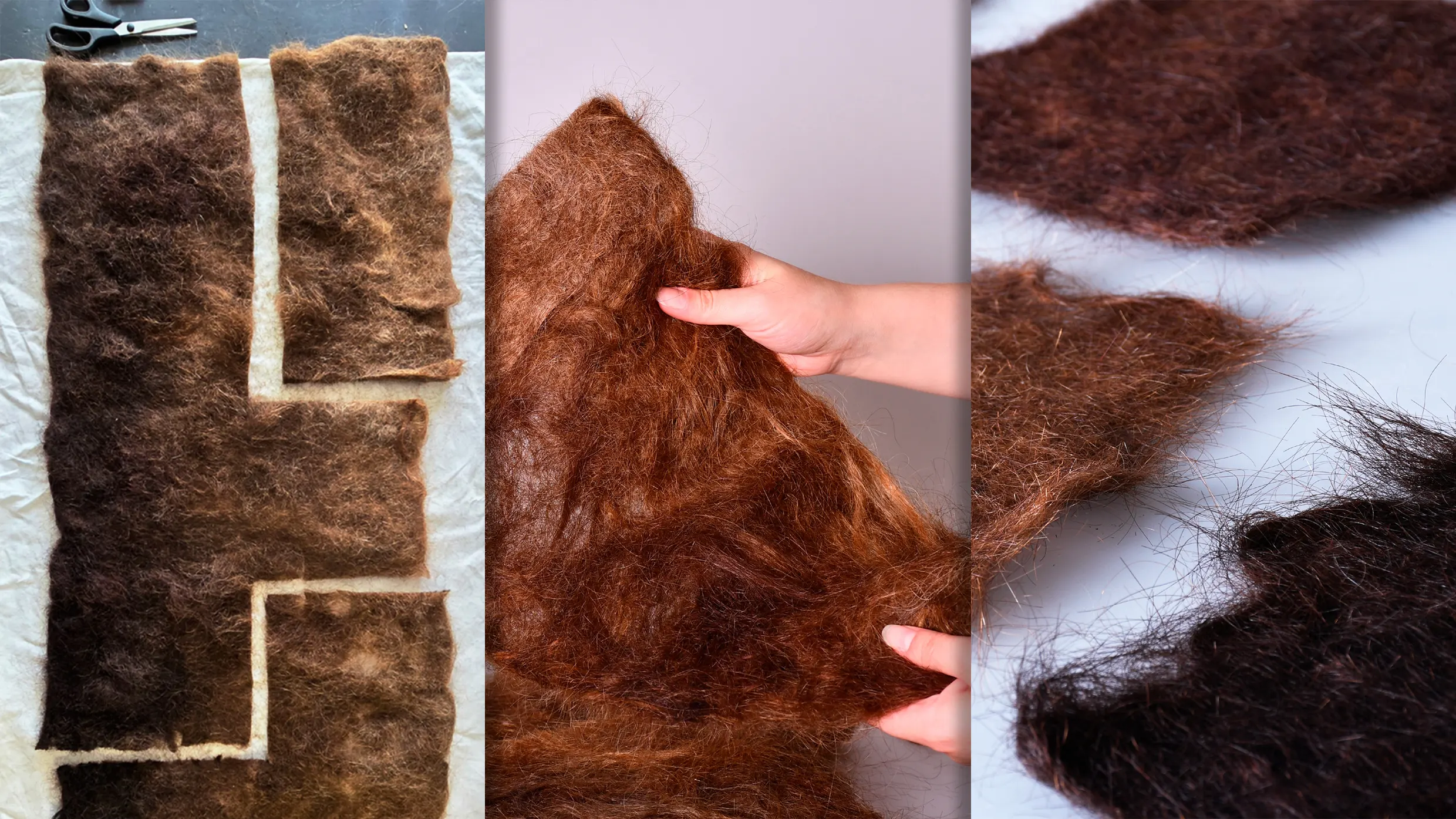
"Designer Laura Oliveira collected clippings at two Portugese hair salons for her master's thesis in product and industrial design at the University of Porto in Portugal. (The hair was donated anonymously after the two salons signed informed consent forms.) Oliveira received several large bags' worth of hair that she cleaned and sorted by color, texture, and length. Over the course of the project, she developed what she calls a "hairbraium," an archive of categorized human hair samples that she used as her materials library."
"Oliveira made her biotextiles by applying various textile techniques to hair, like carding, wet felting, and needle felting. The felted biotextiles were slightly scratchy, but structured and dense, "similar to coarse wool," she says. She also experimented with other, more unconventional methods, like combining hair with glycerin, agar-agar, and pine resin. When combined with pine resin, which is usually brittle when solid, the hair absorbed it and improved its resistance and structural stability."
Clippings were collected at two Portuguese hair salons, donated anonymously after informed consent. The hair was cleaned and sorted by color, texture, and length and archived in a 'hairbraium' materials library. Various textile techniques such as carding, wet felting, and needle felting produced felted biotextiles that were structured, dense, and slightly scratchy, similar to coarse wool. Experiments combined hair with glycerin, agar-agar, and pine resin; hair absorption of pine resin improved resistance and structural stability of the resin. Historical and contemporary precedents exist, including medieval Peruvian hair textiles and companies turning hair into yarns.
Read at Fast Company
Unable to calculate read time
Collection
[
|
...
]