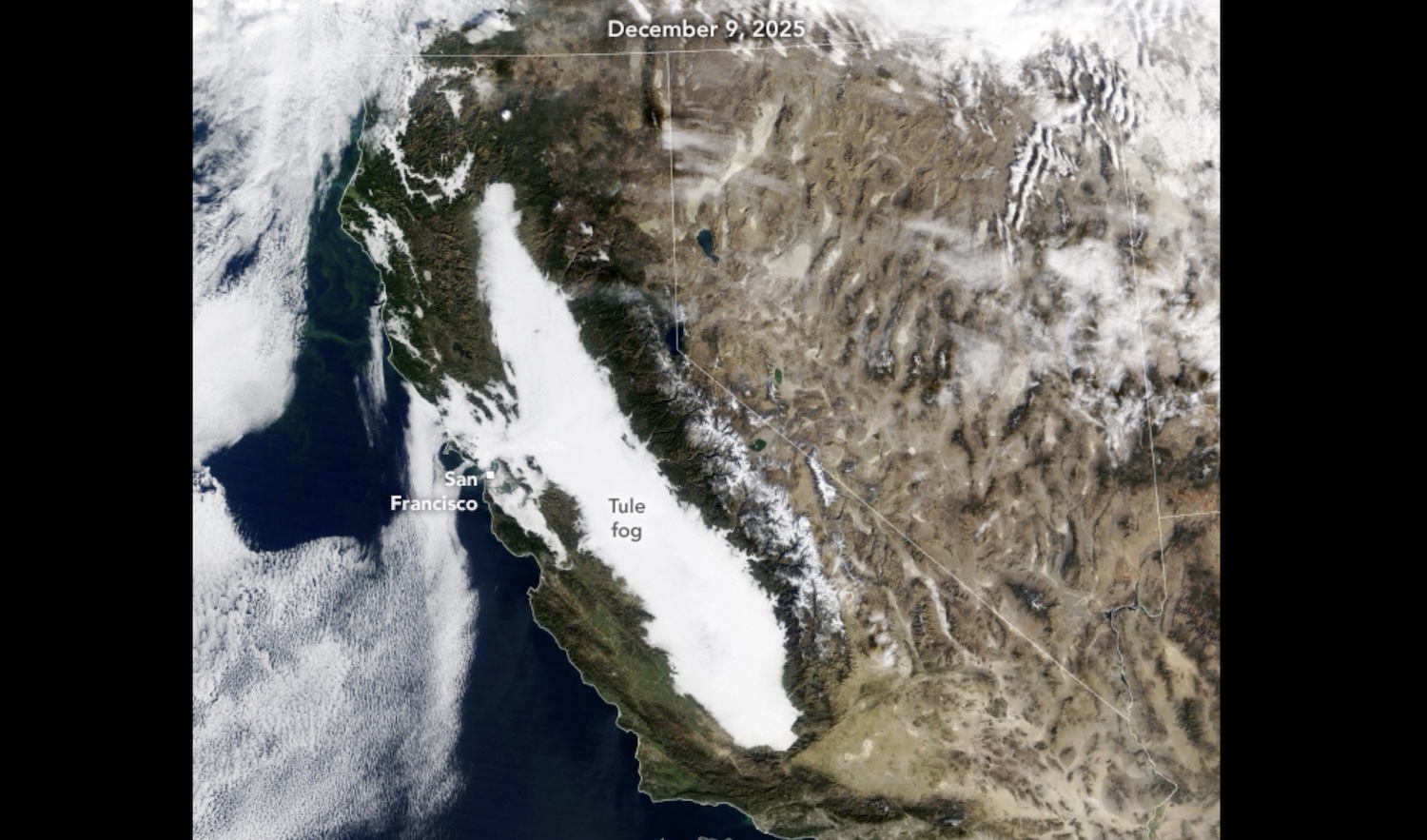
California's Central Valley is a 400-mile flatland bounded by the Sierra Nevadas and the Coast Ranges, with fertile soil formed by mountain erosion draining through the San Francisco Bay. Roughly 600,000 years ago the valley held a Lake Michigan-sized inland body of water known as Lake Corcoran. Present-day tule fog acts like an aerosolized rebirth of that paleolacustrine feature and has persisted across the valley for nearly a month. NASA satellite imagery shows the fog's extent and persistence. Cities including Sacramento, Fresno, and Stockton have experienced dense, daily mist since Nov. 21, severely reducing visibility for residents.
"California's Central Valley is a 400-mile long expanse, penned in by the Sierra Nevadas to the East and the Coast Ranges to the west. The flatland is composed of remarkably fertile soil, as both mountain ranges erode into and drain out through the valley via the San Francisco Bay. Before the bay was formed roughly 600,000 years ago, geological evidence suggests there was a Lake Michigan-sized inland body of water (referred to as Lake Corcoran in the literature) spanning most of the valley."
"While the region's paleolacustrine situation is not directly relevant to the present-day weather situation, both are products of Northern California's remarkable topography. Also, the present-day fog is essentially an aerosolized lake, Corcoran reborn in the sky. NASA published satellite images showing the persistence of the phenomenon. This is the tule fog, and it has trapped the Central Valley in a moist, misty prison for nearly a month."
""It has been two weeks since I have seen the sun here in Sacramento," local resident Dave Redford* said. "The fog seems to get heavier each day and seeps deeper into my mind. I get excited when a breeze comes by and moves the leaves in the back yard even a little. Then it stops and it's back to the still and stifling grayness. The only sign of hope is in the weather forecast.""
Read at Defector
Unable to calculate read time
Collection
[
|
...
]