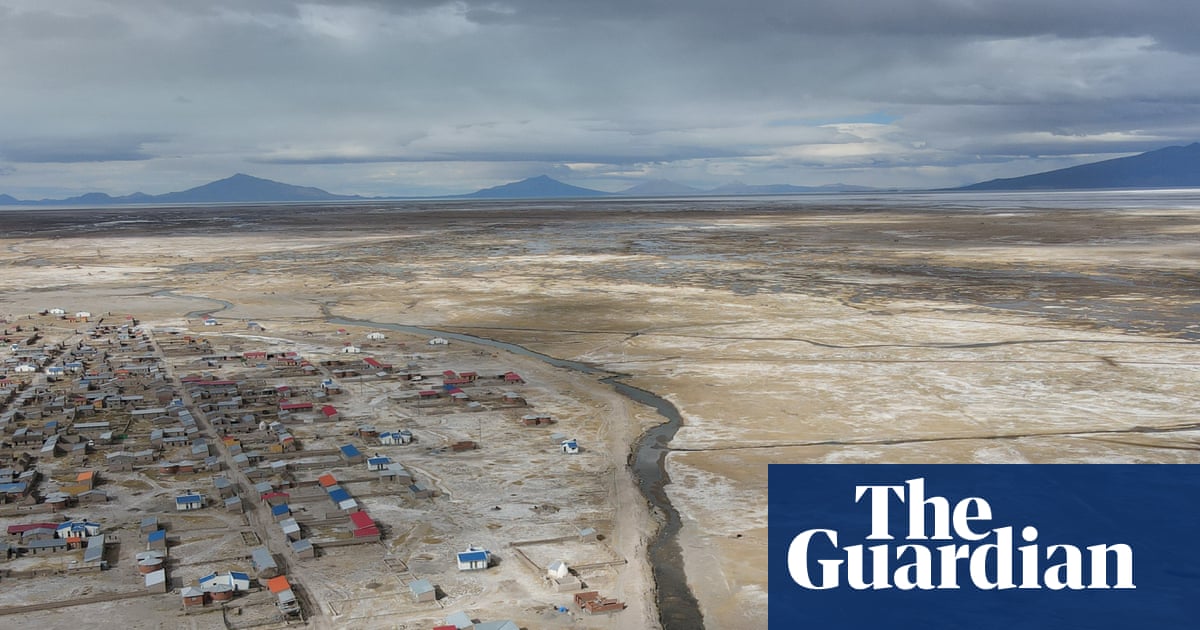
"In the small town of Chipaya, everything is dry. Only a few people walk along the sandy streets, and many houses look abandoned some secured with a padlock. The wind is so strong that it forces you to close your eyes. Chipaya lies on Bolivia's Altiplano, 35 miles from the Chilean border. The vast plateau, nearly 4,000 metres above sea level, feels almost empty of people and animals, its solitude framed by snow-capped volcanoes. It raises the question: can anybody possibly live here?"
"The Uru Chipaya are at risk of extinction as the climate crisis dries up their land and their way of life. Once known as the people of water, they have seen drought, rising salt levels and migration push their traditions to the brink. An interactive slider' showing satellite photos of a lake drying up almost entirely between 2013 and 2016 Lake Poopo, once Bolivia's second-largest lake and an important fishing resource for local communities, has dried up"
"The nearby Lake Poopo, once the second largest in Bolivia, has vanished and crops are failing. As a result, most of Chipaya's 2,000 inhabitants have left for Chile to work. Local leaders say poverty, cultural erosion and health problems from salty water threaten those who remain. Gabriel Moreno, an anthropologist at Bolivia's Technical University of Oruro, says: The Uru Chipaya are part of Bolivia's cultural heritage. It's one of the oldest Indigenous cultures in Latin America, dating back 3,000 to 4,000 years."
Chipaya sits on Bolivia's Altiplano about 35 miles from the Chilean border at nearly 4,000 metres elevation. The town is parched, wind-swept and sparsely populated, with many abandoned or padlocked houses. The Uru Chipaya people face drought, rising salinity and vanishing water sources that undermine traditional fishing and agriculture. Lake Poopo, once Bolivia's second-largest lake, has largely dried up, exacerbating crop failure. Most of Chipaya's roughly 2,000 residents have migrated to Chile for work. Remaining residents confront poverty, cultural erosion and health problems linked to salty water. The Uru Chipaya are one of the oldest Indigenous cultures in Latin America, dating back 3,000–4,000 years.
Read at www.theguardian.com
Unable to calculate read time
Collection
[
|
...
]