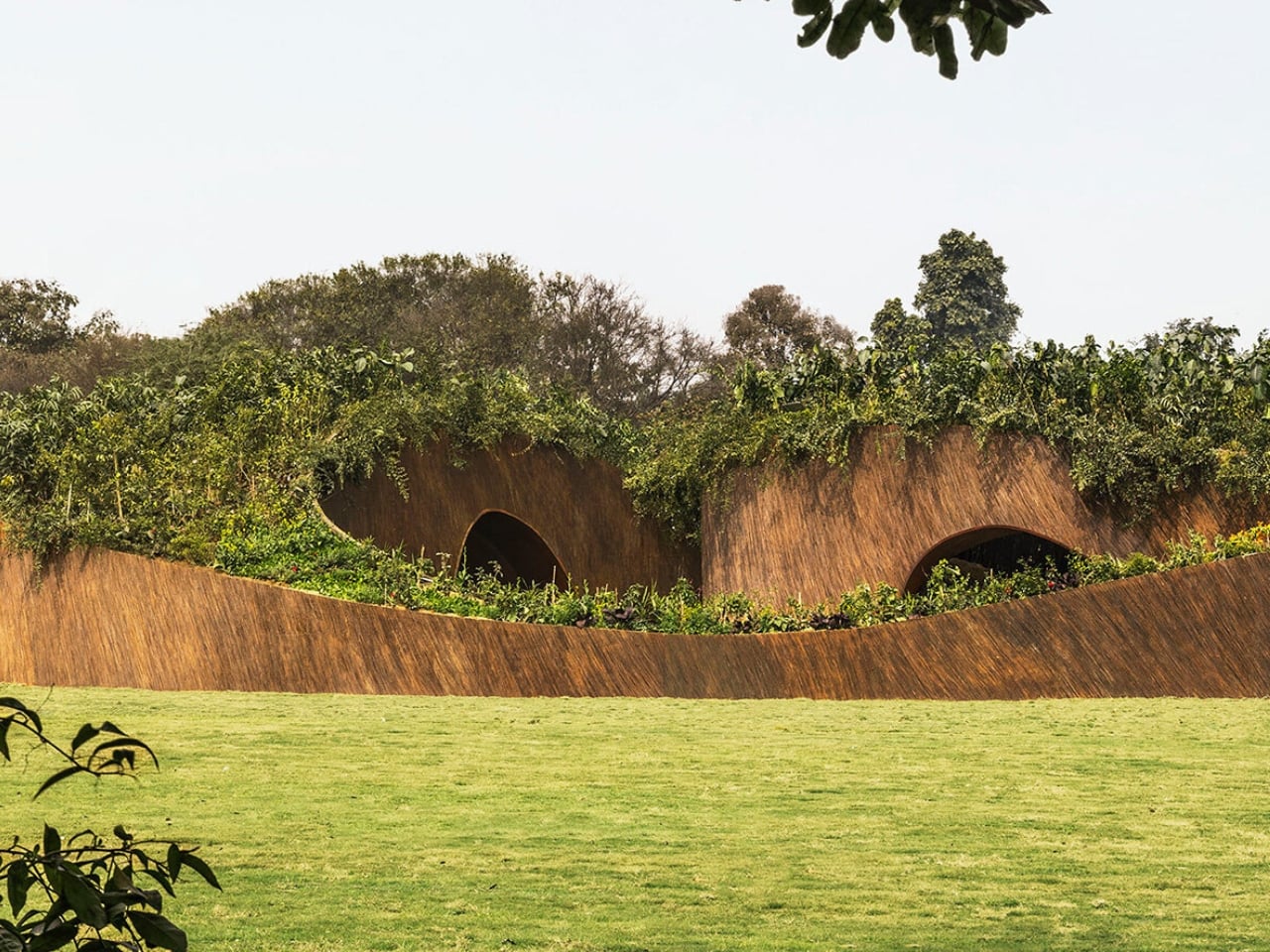
"There's something poetic about turning your worst problem into your best solution. That's exactly what's happening at Delhi's Sunder Nursery, where a stunning new pavilion is literally made from one of India's most hated plants. The Aranyani Pavilion looks like a small spiral rising from the lawns, but get closer and you'll realize its walls are woven from lantana, a plant that's basically the uninvited guest that took over the whole house. Brought to India centuries ago as an ornamental plant, lantana camara has spread like wildfire across the country. Today, it covers over 13 million hectares and has invaded 44 percent of India's forest cover, choking native species and creating dense, impenetrable barriers that prevent new growth."
"The pavilion occupies a 200-square-meter footprint and features a bamboo skeleton that holds up walls crafted entirely from upcycled lantana stems. The structure spirals inward, creating a rib-like cage that guides visitors toward the center, where a nine-ton rock that was once mining waste sits in a shallow, reflective pool. Above it all, a living canopy of jasmine, neem, tulsi, and bakul plants creates a roof that breathes and grows."
"What makes this project so compelling isn't just the clever upcycling angle. It's the entire philosophy behind it. The pavilion is inspired by India's tradition of sacred groves, those ancient forest sanctuaries where communities protected nature as a spiritual act. By using the very plant that destroys these ecosystems and transforming it into something that honors them, the designers have created a kind of architectural karma."
The Aranyani Pavilion at Sunder Nursery is constructed with walls woven from upcycled lantana stems supported by a bamboo skeleton, occupying a 200-square-meter footprint. The spiral structure creates a rib-like cage leading to a center with a nine-ton rock, formerly mining waste, set in a shallow reflective pool. A living canopy of jasmine, neem, tulsi, and bakul forms a breathing, growing roof. Lantana camara, introduced as an ornamental, now covers over 13 million hectares and has invaded 44 percent of India's forest cover, choking native species and preventing regeneration. The pavilion repurposes the invasive plant and draws inspiration from sacred grove traditions to honor and restore ecological values.
Read at Yanko Design - Modern Industrial Design News
Unable to calculate read time
Collection
[
|
...
]