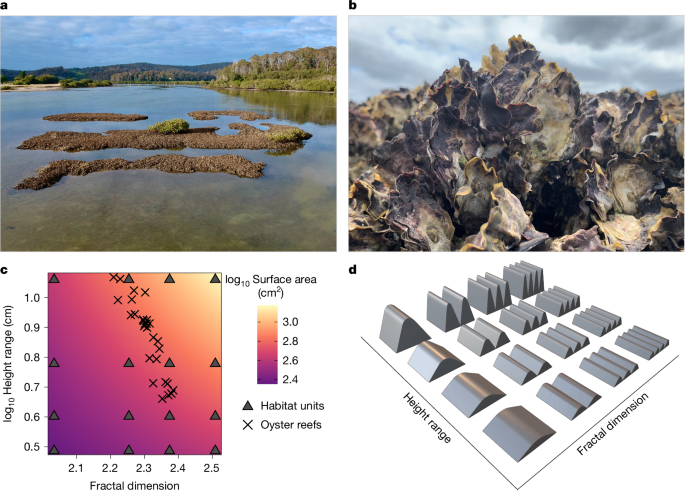
Habitat structural complexity—the three-dimensional architecture of habitat space—increases surface area and therefore supports greater numbers of individuals and higher biodiversity. Structural complexity mediates biotic and abiotic stressors by creating microhabitats that reduce heat stress and mitigate predation, enabling species establishment and persistence in otherwise uninhabitable areas. Many iconic complex habitats form through the activities of ecosystem engineers that manipulate biotic or abiotic materials and alter resource and habitat availability. Habitat modifications by engineers profoundly affect species distribution, abundance, and trophic relationships. In marine systems, structural complexity can decouple or weaken predator–prey interactions, protecting recruits.
"Habitat structural complexity-the architecture of habitat space-is a key driver of species abundance and biodiversity throughout Earth's ecosystems1,2. Highly complex, three-dimensional habitats tend to support greater numbers of individuals than simple, planar habitats because abundance scales with area10 and surface area increases with habitat complexity2,11. Habitat structural complexity also confers further benefits to species that extend beyond an increase in area, including the mediation of biotic and abiotic stressors2."
"For example, along intertidal shorelines, areas of high structural complexity create shaded microhabitats that protect inhabitants against heat stress at low tide12,13 and mitigate predation14. By mediating biotic and abiotic interactions, habitat structural complexity allows the establishment and persistence of species in areas that would otherwise be uninhabitable2,15. Many of the planet's most iconic structurally complex habitats arise from the activities of ecosystem engineers-organisms that manipulate biotic or abiotic materials and by doing so, alter resource and habitat availability3,4."
Read at Nature
Unable to calculate read time
Collection
[
|
...
]