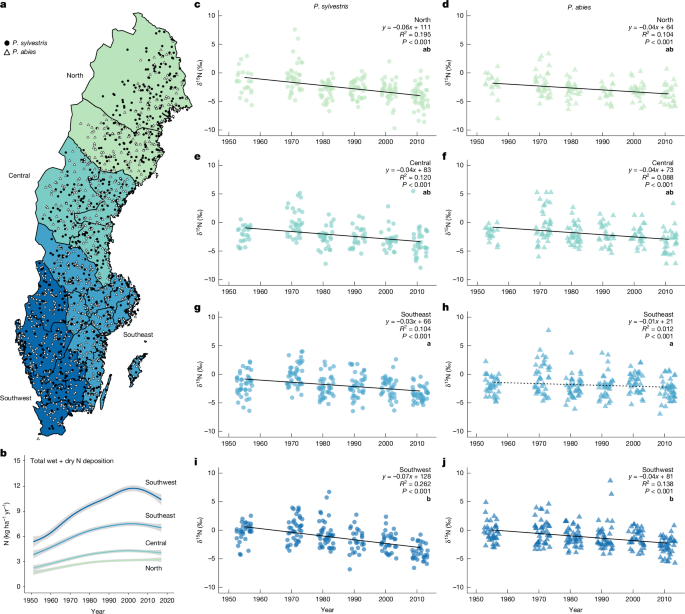
"Since 1960, humans have increased the rate of reactive nitrogen (Nr) creation by a factor of 10 owing to the industrial Haber-Bosch process, expansion of leguminous crops and fossil fuel combustion; and Nr creation is expected to increase by a factor of 18 by 2050 (ref. 11). In addition, considerable atmospheric Nr emissions and subsequent deposition of NHx and NOy to Earth's surface occur as a consequence of global energy and food production12."
"At the same time, human activities have increased atmospheric carbon dioxide (CO 2) concentrations by more than 50% since the start of the industrial age, which has been shown to enhance terrestrial net primary productivity (NPP)14,15. Furthermore, enhanced NPP from rising atmospheric CO 2 has been proposed to interact with the N cycle, potentially reducing N availability and intensifying N limitation of terrestrial NPP (referred to as progressive N limitation (PNL)16 or ecosystem oligotrophication2,17)."
Human-induced changes have substantially altered global nitrogen and carbon cycles, bringing several Earth-system boundaries close to or beyond their limits. Reactive nitrogen (Nr) creation increased tenfold since 1960 due to the Haber-Bosch process, expanded leguminous cropping, and fossil fuel combustion, and is projected to rise further by 2050. Atmospheric Nr emissions and deposition of NHx and NOy have enriched ecosystems, causing eutrophication and acidification in high-input regions. Atmospheric CO2 concentrations have risen over 50% since the industrial era, enhancing terrestrial net primary productivity (NPP). Enhanced NPP can interact with the N cycle, potentially causing progressive N limitation via increased plant N uptake or greater microbial N immobilization, creating uncertainty in future terrestrial N limitation and implications for the terrestrial carbon sink.
Read at Nature
Unable to calculate read time
Collection
[
|
...
]