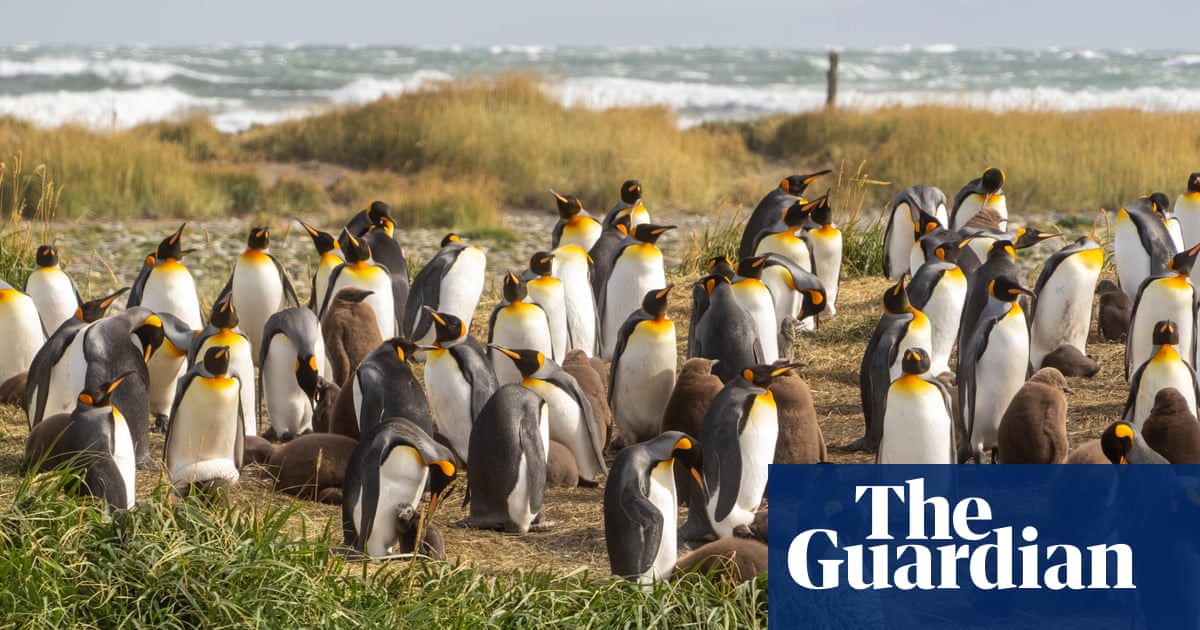
"Five pairs of rubbery feet carry velvet-sheathed black-and-white bodies towards the rope line separating the king penguins from the dozen or so visitors, who look on in awe. As these emissaries shuffle over, a hundred of their cohorts parade on a nearby bank, splashing around in the water and regurgitating food into their chicks' open beaks."
"The king penguin (Aptenodytes patagonicus) makes its home almost exclusively on islands in the Southern Ocean. But it has been coming to this wind-battered bay in southern Chile's Tierra del Fuego region for hundreds of years, probably because its shallow shores offer protection from marine predators and humans. Useless Bay was so called because its shallow shores made landing boats nearly impossible."
"Still, humans remained such a threat that no permanent colony of king penguins formed here until 2010. Then, as a colony started to develop, a local landowner and former kindergarten teacher Cecilia Duran Gafo, now 72, decided she would protect them. They dressed them up in caps and sunglasses, and took selfies."
"Duran's reserve is part of a growing global trend. A 2022 study in Nature Ecology and Evolution, assessing more than 15,000 private protected areas, found they helped to conserve underrepresented biomes and highly threatened regions that government action alone could not reach. It was only thanks to the reserve that [the penguins] got a safe space where they could build up and establish a colony."
King penguins move in groups toward a rope line that separates them from visitors. Nearby, many penguins swim and feed their chicks by regurgitating food. The species lives mainly on Southern Ocean islands, but has long visited a wind-battered bay in southern Chile’s Tierra del Fuego region. Shallow shores once made landing boats nearly impossible, leading early explorers to call the place Useless Bay. Human pressure prevented a permanent colony until 2010. A local landowner, Cecilia Duran Gafo, created a reserve to protect the penguins, including public engagement and safety measures. The reserve helped establish a safe space for colony growth. Private protected areas are increasingly recognized for conserving threatened regions that government efforts may miss.
Read at www.theguardian.com
Unable to calculate read time
Collection
[
|
...
]