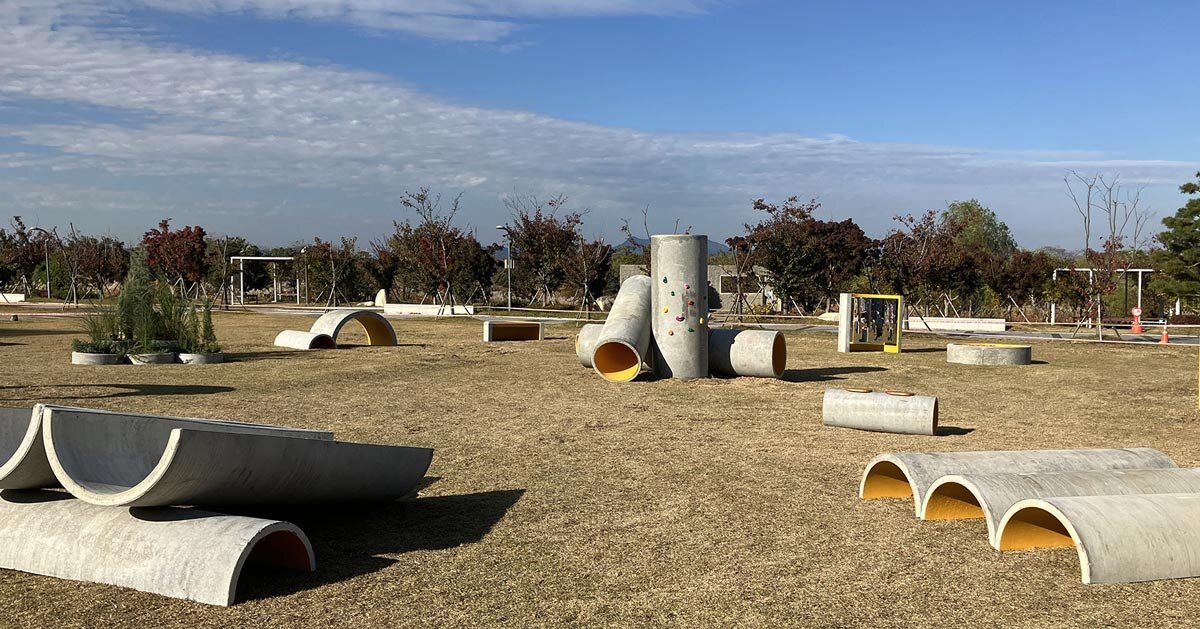
"Concrete, second only to water in global consumption, generates significant greenhouse gas emissions during production. In response to the climate crisis and the material dominance of contemporary cities, the project addresses the condition of the 'concrete city' through the adaptive reuse of abandoned infrastructure. Rather than introducing new materials, the installation reclaims discarded concrete pipes found in urban environments and reorganizes them into inhabitable structures."
"Pipes of varying diameters are assembled into a flexible configuration that accommodates multiple forms of occupation. The arrangement allows for climbing, sitting, circulation, and gathering, transforming industrial components into spatial devices. By retaining the original identity of the pipes while altering their function, the project shifts perception from infrastructure to architecture."
"Conceived as a micro-scale urban environment, Concrete Utopia operates as both pavilion and metaphor. Its open-ended composition avoids fixed hierarchy, enabling visitors to navigate and interpret the space in different ways. The repetitive circular geometries reference standardized construction systems while simultaneously disrupting their original purpose. Through direct engagement with reused concrete elements, the project by designer Hyunje Joo frames urban resilience as a matter of material reconsideration and spatial reorganization. By extending the lifecycle of construction waste, Concrete Utopia positions reuse not on"
Concrete Utopia reconfigures discarded concrete pipes into an open-ended public pavilion at the Museum of Contemporary Art Busan in South Korea. The installation highlights concrete's heavy global consumption and carbon-intensive production and responds by adaptively reusing abandoned infrastructure instead of introducing new materials. Reclaimed pipes of varying diameters are assembled into flexible, inhabitable configurations that support climbing, sitting, circulation, and gathering while retaining their original identity. The composition acts as a micro-scale urban environment whose repetitive circular geometries reference standardized construction systems while disrupting their original purpose, framing urban resilience as material reconsideration and spatial reorganization and extending construction waste lifecycles.
Read at designboom | architecture & design magazine
Unable to calculate read time
Collection
[
|
...
]