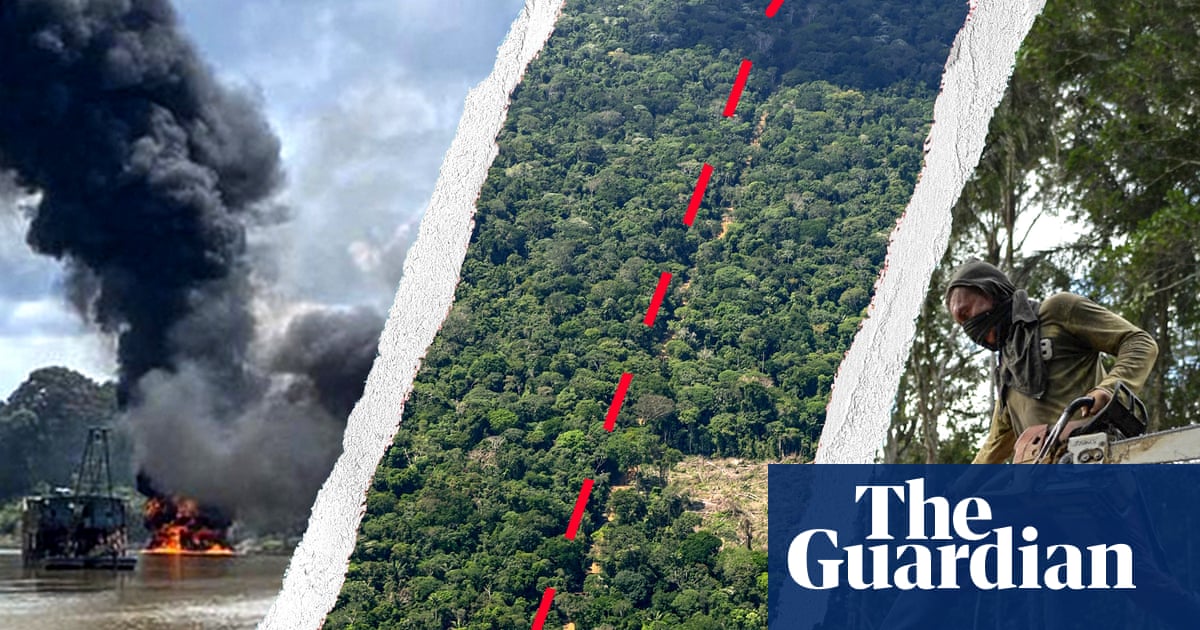
"High above the Colombian Amazon, Rodrigo Botero peers out of a small aircraft as the rainforest canopy unfolds below an endless sea of green interrupted by stark, widening patches of brown. As director of the Foundation for Conservation and Sustainable Development (FCDS), he has spent years mapping the transformation of this fragile landscape from the air. His team has logged more than 150 overflights, covering 30,000 miles (50,000km) to track deforestation advancing along the roads, illicit crops and the shifting frontiers of human settlement."
"Colombia now has the highest road density in the Amazon. Photograph: Rodrigo Botero/FCDS Yet the infrastructure he describes is not necessarily a sign of progress or social development, but mostly a network of illegal routes expanding in southern Colombia across the Amazon forest, which covers 42% of the country. Since 2018, various armed groups have built more than 8,000km of roads there, spreading like arteries through the jungle."
Aerial mapping and more than 150 overflights covering 30,000 miles document accelerating deforestation, illicit crops and expanding human settlement across Colombia's Amazon. The Amazon covers 42% of Colombia and now has the highest road density in the entire basin, driven largely by illegal routes. Since 2018, armed groups have built over 8,000km of roads that function as arteries for exporting cocaine, gold and meat to meet international demand. The north-western Amazon hosts 17 illegal groups operating in nearly 70% of municipalities and registers some of the world's highest socio-environmental conflict levels. Macro-criminal networks link armed groups, gangs, cartels, political intermediaries and business conglomerates, seizing resources and degrading ecosystems.
Read at www.theguardian.com
Unable to calculate read time
Collection
[
|
...
]