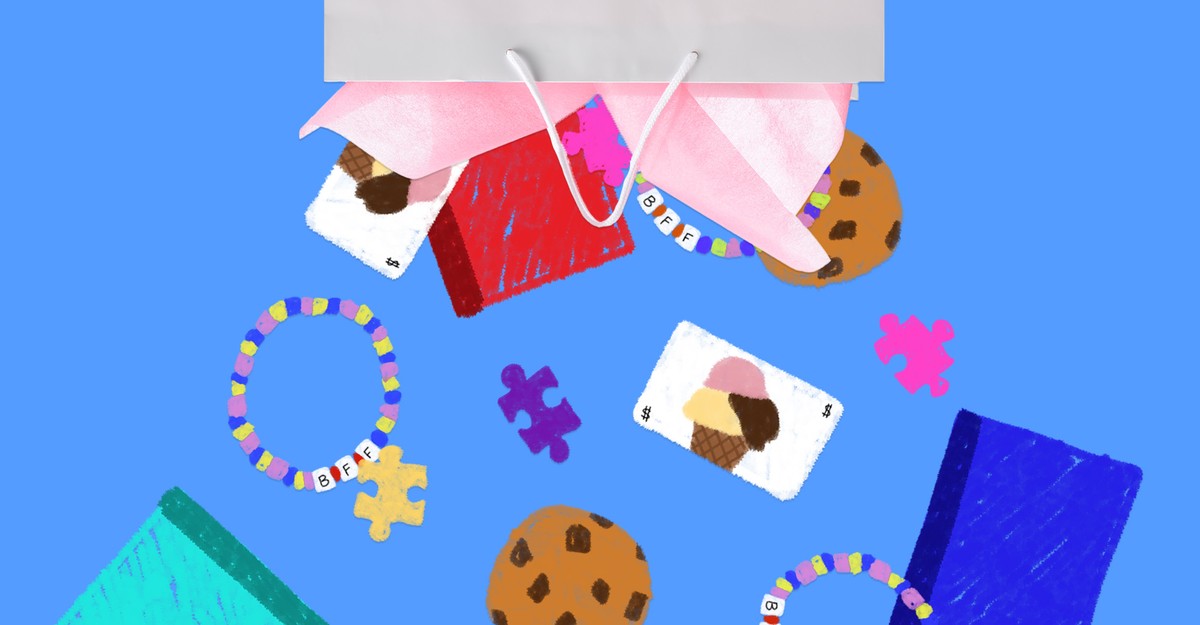
"The worst offenders, though, are the goody bags. This year, my kids received them at Valentine's Day, Ramadan, Easter, Halloween, and many birthday parties. Every time they bring one home, they dump its contents on the living-room floor and pick through their treasures with glee. But soon enough, the tiny fire truck has lost its wheels and a fight has broken out over whose Care Bears keychain is cooler, though neither of my children has ever owned a key."
"I know that the gifts are a gesture of celebration. But it's also true that plastic takes at least a century to decompose (and typically far longer) and that the goodies are, as Chip Colwell, an anthropologist and the author of So Much Stuff, told me, commonly the product of extraordinarily cheap labor. That broken fire truck will almost certainly outlive my children, either in a landfill or, worse, in the ocean-all for a few minutes of play."
A parent who tried to live lightly finds household clutter increasing after having children. Family members and service providers regularly gift toys and inflatables that occupy storage space. Goody bags from holidays and parties produce frequent small plastic items that children initially enjoy but soon discard or break. Many of these single-use toys are made with cheap labor and contain plastics that take at least a century to decompose. Broken items often end up in landfills or the ocean long after a few minutes of play. Social pressure and the desire to be generous drive continued distribution of such favors.
Read at The Atlantic
Unable to calculate read time
Collection
[
|
...
]