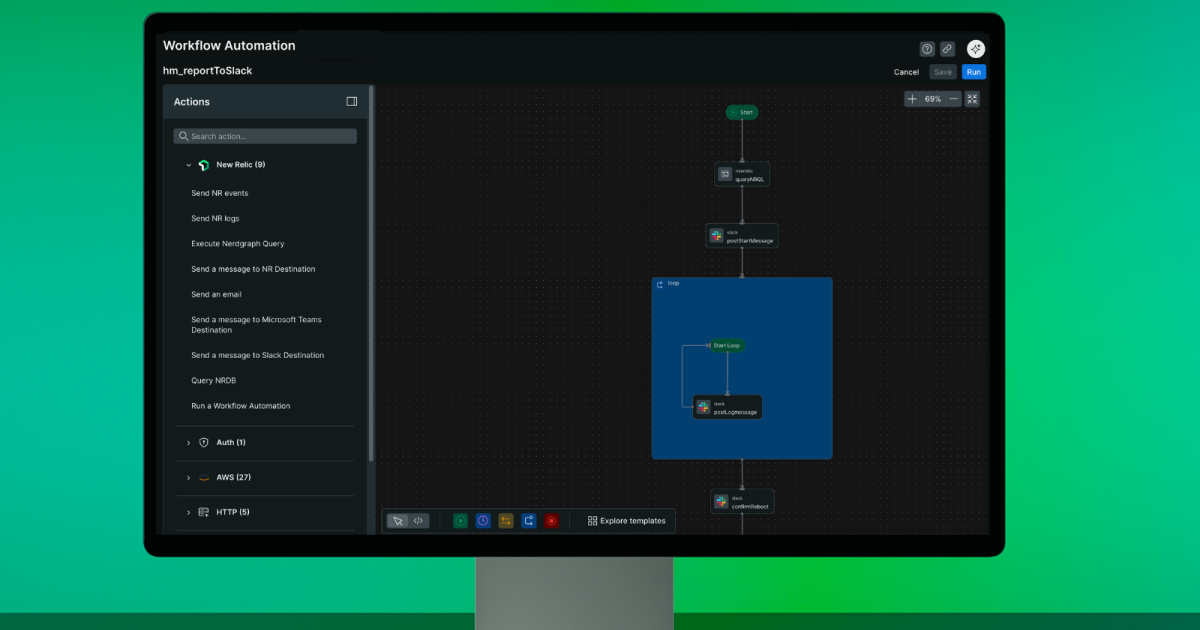
"Your team deploys a new release to production. Workflow Automation monitors your deployment with a marker in New Relic. An anomaly is detected where error rates spike above baseline. The workflow sends a message with diagnostic logs and posts to your team's Slack channel. Your engineer approves with a single Slack reaction. The workflow automatically rolls back to the previous version. Within minutes, systems return to normal."
"Organizations testing Workflow Automation are seeing measurable results: Reduction in MTTR by eliminating manual triage and remediation steps, Reduction in operational toil, freeing engineers to focus on innovation, Fewer customer-impacting incidents through automated issue resolution."
"A Fortune 100 restaurant company with mobile ordering across 100+ international markets automated their app release process with Workflow Automation. The solution enabled deployment teams to detect health issues during gradual rollouts and pause releases automatically, reducing manual triage time and improving customer experience metrics."
Workflow Automation transforms incident response by automating deployment rollbacks triggered by anomaly detection. When error rates or performance metrics degrade following a production deployment, the system automatically alerts the team via Slack with diagnostic information and requests approval for rollback through a single reaction. This eliminates manual investigation and triage, reducing MTTR significantly while maintaining full audit logs. Organizations implementing this approach experience reduced operational toil, fewer customer-impacting incidents, and faster incident resolution. Real-world examples include a Fortune 100 restaurant company automating app releases across international markets and a Fortune 500 financial services firm automating EC2 instance management with automatic restarts based on CPU thresholds.
#automated-deployment-rollbacks #incident-response-automation #mttr-reduction #production-monitoring #operational-efficiency
Read at New Relic
Unable to calculate read time
Collection
[
|
...
]