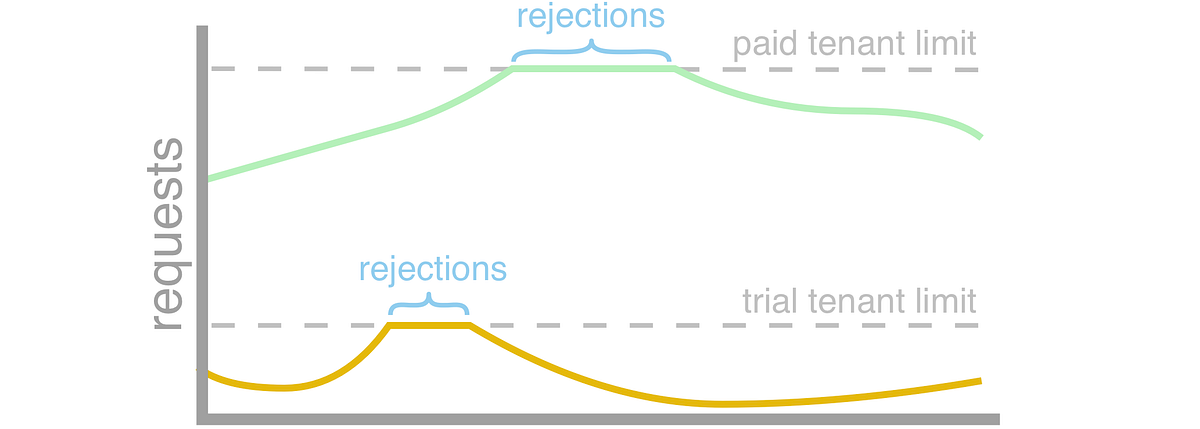
"Fair multitenancy is a set of controls ensuring each customer gets a fair share of the infrastructure. A fair share is not necessarily an equal share, as customers may have different quotas based on their tier or status."
"A bug on the customer side, natural rapid growth, or misuse of API can cause one tenant to unintentionally consume most of the capacity of the entire infrastructure or a particular node."
"DDOS protection is not enough. Most DDOS attack types do not result in proper requests and are rejected as bad or non-authenticated, but fair multitenancy controls can provide some protection against these attacks."
"Rate-limiting is the most straightforward approach to managing load, but the rate of events is often less critical than concurrency, which is much harder to track in distributed systems."
Fair multitenancy involves shared infrastructure among multiple users, ensuring each customer receives a fair share based on their tier or status. Issues like bugs or rapid growth can lead to one tenant consuming excessive resources, impacting others. While DDOS protection is common, it does not ensure fair multitenancy. Rate-limiting is a basic method for managing load, but concurrency is more critical and challenging to monitor in distributed systems, affecting overall performance and fairness.
Read at Medium
Unable to calculate read time
Collection
[
|
...
]