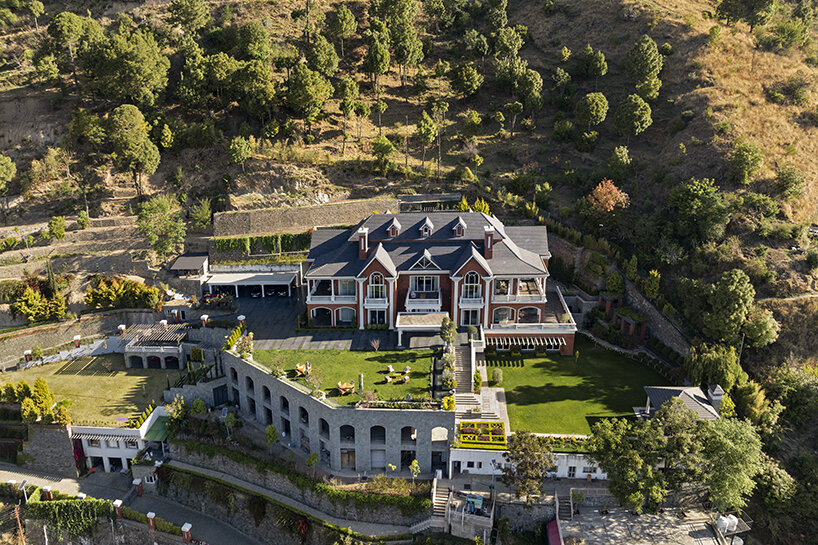
Solan Hill House sits embedded into a steep site in Himachal Pradesh, with form generated by the landscape and contours. The project arranges living spaces across stepped plates that follow natural gradients, minimizing excavation and heavy cut-and-fill. The architecture reduces visual exposure while maximizing views and privacy by sitting low within the terrain. Material choices emphasize durability, long-term adaptability, and environmental performance. Habitat Architects applied a restraint-led approach grounded in spatial logic, proportion, and construction systems to create a quiet dialogue between built form and topography. Design responds to complex site gradients, access conditions, and visual exposure, using the landscape as a generator of form, structure, and spatial sequence.
"Designed by Habitat Architects, the Solan Hill House is a private residence embedded into a sloping site in Himachal Pradesh, conceived as an architecture that grows out of its terrain rather than resting on it. Completed as a response to complex gradients, access conditions, and visual exposure, the project uses the landscape itself as a generator of form, structure, and spatial sequence."
"At their Hill House project, the sloping site is not treated as a constraint but as a framework that defines planning and movement. The architecture unfolds across a series of stepped plates that follow the natural gradient, reducing the need for heavy cut-and-fill operations. This approach preserves the integrity of the terrain while allowing the building to sit low and embedded within the landscape."
#landscape-led-design #stepped-plate-architecture #residential-architecture #site-responsive-planning
Read at designboom | architecture & design magazine
Unable to calculate read time
Collection
[
|
...
]