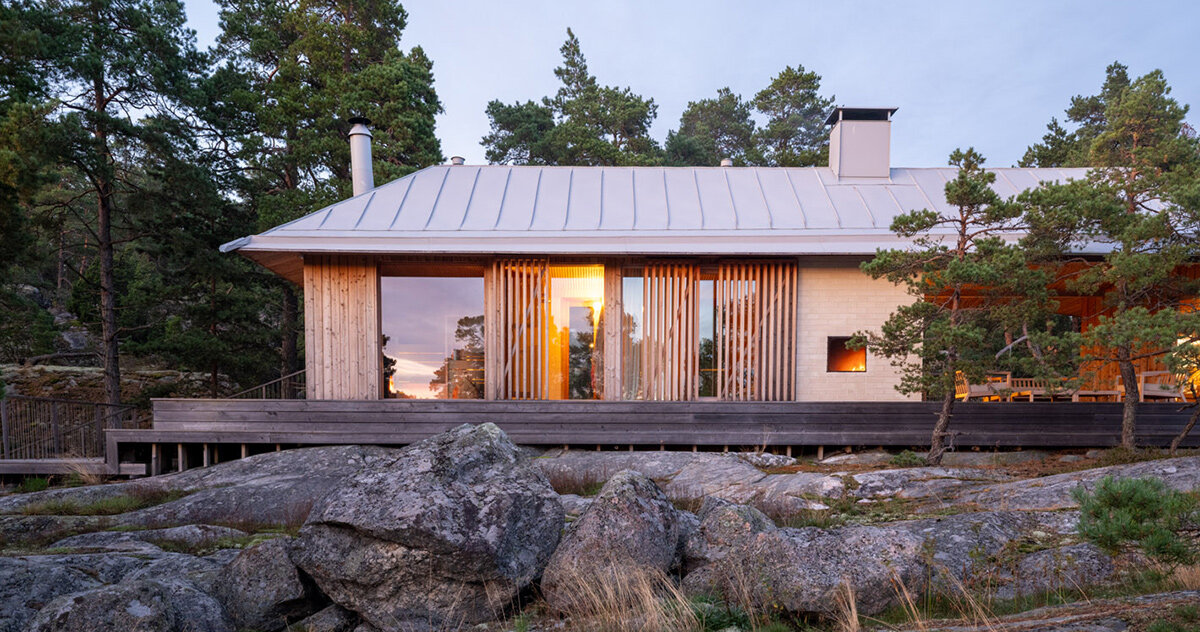
"A newly completed house by Mer Architects sits on a rocky island known as Långholmen in a Finnish coastal archipelago. The site lies among granite and gneiss outcrops shaped by post-glacial uplift, with pine trees rising directly from shallow soil pockets along the shore. Långholmen is defined by high, smooth rock faces and a dense ground layer of mosses and lichen. The timber building occupies a narrow zone between exposed stone and mature pines, positioned to follow the existing contours rather than clearing them."
"Arrival takes place from the open sea into a sheltered cove, where a large timber jetty functions as the primary outdoor living surface. The jetty reads as an extension of the shoreline, wide enough for gathering yet low against the water. From this point, an elevated timber path leads through reeds and a small stand of pines. The house appears gradually between tree trunks, with movement guided along a decked route that passes the rear facade before turning inward toward the center of the plan."
"Mer Architects' house on Långholmen island is composed of two compact volumes unified beneath a single folded roof. One volume contains the sauna suite with shower and changing space, while the other holds a combined living and sleeping room. Between them, a covered outdoor room operates as the spatial hinge. Its position at the midpoint of the plan draws attention to the opening toward the sea, framed by roof planes and timber edges rather than glazing alone."
The project sits on Långholmen, a rocky island of granite and gneiss with shallow soil pockets where pines rise directly from the bedrock. The timber house occupies a narrow band between exposed stone and mature trees and follows existing contours rather than altering them. Arrival is from the sea into a sheltered cove where a broad timber jetty functions as the primary outdoor living area. An elevated timber path guides movement through reeds and pines toward the house. Two compact volumes are unified by a folded roof and separated by a covered outdoor room that frames a focused view to the sea. A light brick wall with a diagonal open fireplace provides thermal mass within the timber structure.
Read at designboom | architecture & design magazine
Unable to calculate read time
Collection
[
|
...
]