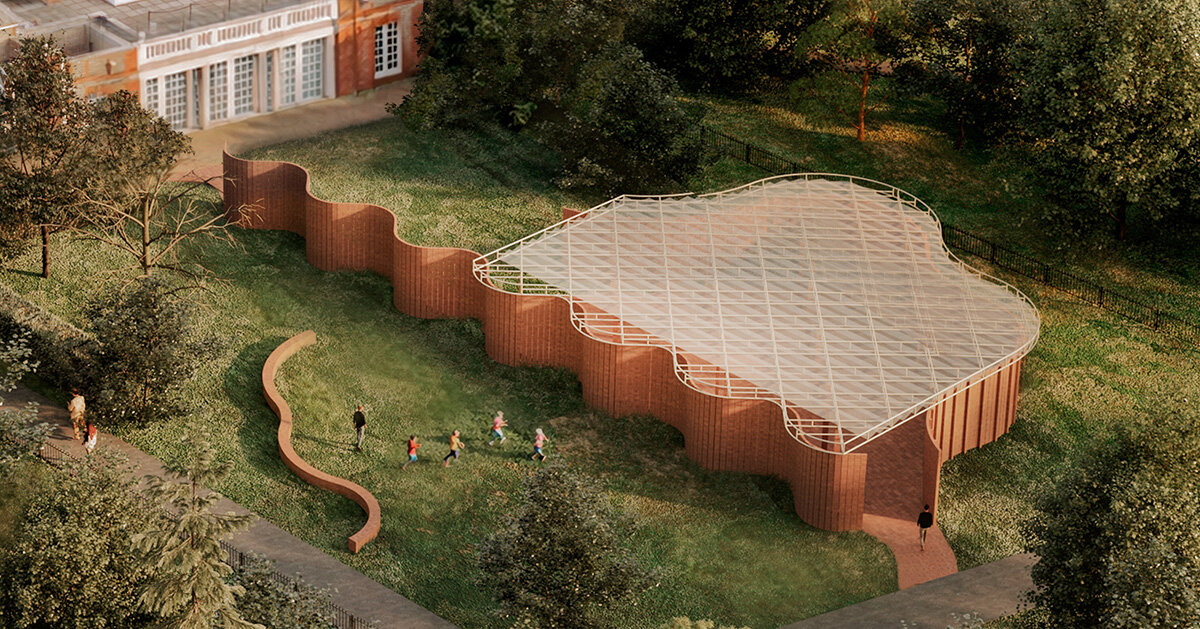
"Mexican architecture studio LANZA atelier, founded by Isabel Abascal and Alessandro Arienzo, is appointed to design the Serpentine Pavilion 2026. Titled 'a serpentine', the pavilion will open to the public on June 6th, 2026, at Serpentine South in London's Kensington Gardens. The announcement coincides with the Pavilion's 25th edition, which Serpentine will mark through a special collaboration with the Zaha Hadid Foundation, reflecting on the legacy of the inaugural pavilion designed by Hadid in 2000."
"a serpentine is shaped by curves, climate, and movement The pavilion is positioned on the northern side of the site and structured through two main walls. One traces the serpentine geometry, while the other aligns with the existing tree canopy. A translucent roof rests lightly on brick columns, evoking a grove of trees and allowing light and air to move freely through the structure."
"Brick is used as the primary material, referencing both the English garden tradition and the existing brick facade of the Serpentine South Gallery, which was originally a tea pavilion itself. Through rhythmic repetition, the brick columns transition from opaque to permeable, creating a gradient of openness. LANZA atelier frames this material strategy as a metaphorical bridge between Europe and the Americas, linking vernacular traditions through shared construction logics rather than symbolic gestures."
LANZA atelier, founded by Isabel Abascal and Alessandro Arienzo, is appointed to design the Serpentine Pavilion 2026, titled 'a serpentine'. The pavilion will open on June 6th, 2026, at Serpentine South in Kensington Gardens and marks the Pavilion's 25th edition alongside a collaboration with the Zaha Hadid Foundation reflecting the legacy of the inaugural 2000 Hadid pavilion. The design draws from the serpentine or crinkle-crankle wall, a historic English feature whose alternating curves provide structural stability and allow a single-brick thickness. The pavilion sits on the northern side with two main walls, a translucent roof resting on brick columns that evoke a grove, and brick elements that transition from opaque to permeable to create a gradient of openness and connect vernacular construction logics across Europe and the Americas.
Read at designboom | architecture & design magazine
Unable to calculate read time
Collection
[
|
...
]