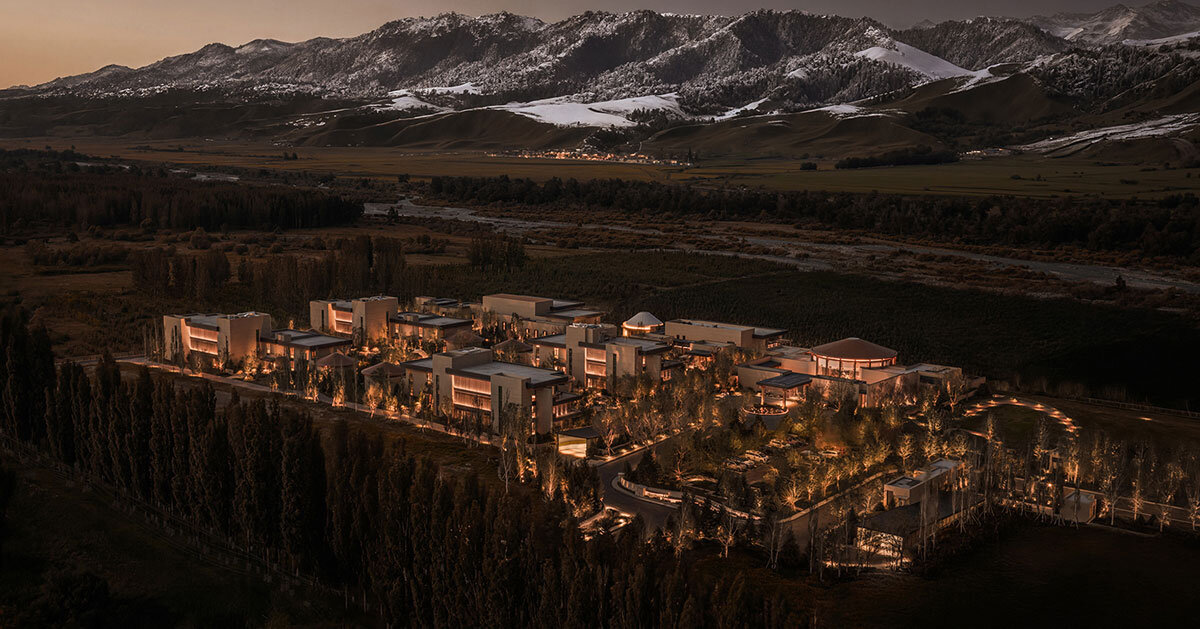
"The architectural language draws from the spatial logic of steppe nomadic life. References to traditional yurts and winter settlements are abstracted into form, circulation, and material choices. Rather than a single mass, the hotel adopts a dispersed layout, with multiple building volumes distributed across the site and connected by winding paths through a forested landscape. From a distance, the complex reads as a clustered arrangement integrated into its surroundings, allowing landscape systems to function as part of the hotel's ecological and spatial framework."
"The arrival sequence is defined by a curved inspired by the geometry of the Nalati sunrise. This canopy shelters the drop-off area and establishes a transitional space between the exterior landscape and interior programs. Warm-toned materials and soft curvature reference the spatial enclosure of an Aul, a traditional Kazakh nomadic settlement. Subtle references to local geography and heritage, including the Tianshan Mountains, Nalati sunrise, Gongnaisi River, and Wusun totem forms, are incorporated into the architectural detailing of the arrival zone."
CCD's design for Hotel Indigo Nalati sits at the junction of the Duku Highway and the Ili 'Figure-8' Scenic Loop in Nalati Town, Ili Kazakh Autonomous Prefecture, Xinjiang. The project frames expansive steppe and Tianshan Mountain views and organizes programming around mausym, the Kazakh concept of seasonality. Architectural language abstracts yurts and winter settlements into dispersed building volumes linked by winding paths through a forested landscape, enabling ecological systems to integrate with the hotel. Arrival is defined by a curved canopy inspired by the Nalati sunrise, using warm materials and soft curvature to evoke an Aul. Lighting and material restraint reinforce framed landscape views.
Read at designboom | architecture & design magazine
Unable to calculate read time
Collection
[
|
...
]