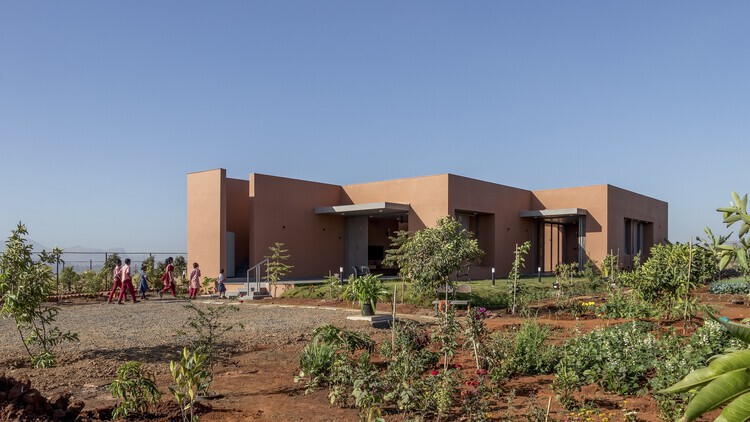
"pk_iNCEPTiON does not begin its projects with form. It begins with people, routines, and the spaces where everyday life unfolds. Across schools, houses, and community buildings, the practice works deliberately with thresholds, shared edges, and moments of overlap, treating architecture not as an object to be admired but as a framework that supports use, change, and occupation over time. Meaning is built gradually, through spatial sequences, calibrated scales, and a careful balance between the built and the unbuilt."
"In Hiwali, a remote farming settlement in the Satmala range, the school avoids the language of an institutional building. Instead, it settles into terraced farmland, shaped by wind, water flow, and the scale of children's bodies. A water moat protects the site from mountain runoff, while a zigzag plinth organizes movement across the sloping terrain. Circulation, seating, and gathering are combined into a single surface, allowing learning to extend beyond enclosed rooms and into daily movement through the building."
pk_iNCEPTiON is based in Maharashtra, India, and works on rural schools, houses, libraries, and public buildings with a focus on spatial organization and adaptability. Projects start from people, routines, and everyday spaces rather than predetermined form, emphasizing thresholds, shared edges, and moments of overlap to support use and change over time. Designs respond to social and climatic contexts through attention to movement, scale, and the relationship between built form and open space. Specific projects integrate landscape and infrastructure—using moats, plinths, voids, and verandahs—to manage water, light, ventilation, privacy, and extend learning into daily movement.
Read at ArchDaily
Unable to calculate read time
Collection
[
|
...
]