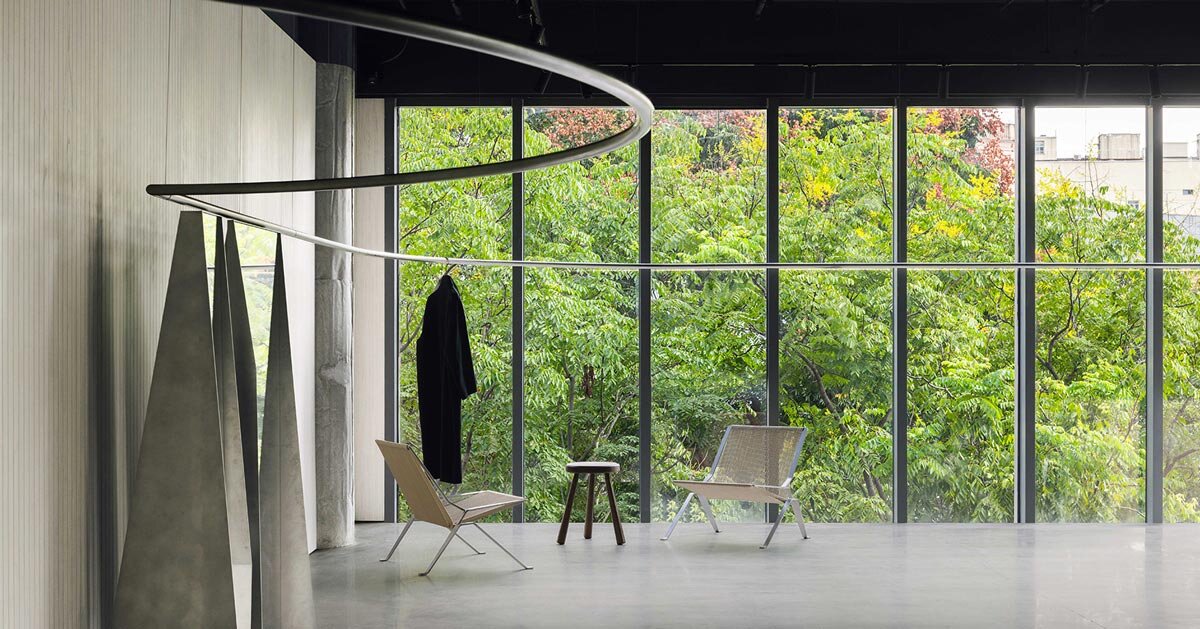
"The project is structured around a single continuous hanging rail that extends for nearly 100 meters, serving as both the primary display system and the organizing element of the space. In response to the constraints of the site, the design reconsiders the hanging rail as a spatial device rather than a fixed retail fixture. The rail adapts to existing walls, columns, and building services, bending, rising, and shifting in section as needed to navigate obstacles."
"Suspended above the floor, the rail maximizes display capacity while defining circulation and visual continuity throughout the showroom. The rail functions as a linear framework that establishes relationships between architecture, garments, and movement. Rather than operating as an isolated object, it responds directly to its surroundings, framing the interaction between displayed clothing and the existing building fabric. Through this strategy, the showroom emphasizes spatial continuity and adaptability over conventional zoning or compartmentalization."
"Complementing the suspended rail system, a series of sculptural concrete display stands are distributed throughout the space. These elements are composed of cast-in-place concrete modules assembled into interlocking configurations. The stands reference the work of sculptor Eduardo Chillida through their mass, material presence, and emphasis on gravity and balance. Their rough textures and inherent imperfections are intentionally preserved, allowing them to function as spatial anchors within the showroom."
YEARLY PLAN showroom is organized by a single continuous hanging rail that runs nearly 100 meters and negotiates an irregular existing plan. The rail adapts to walls, columns, and building services by bending, rising, and shifting in section to navigate obstacles, transforming site constraints into an active spatial sequence. Suspended above the floor, the rail increases display capacity while defining circulation and visual continuity. The rail acts as a linear framework linking architecture, garments, and movement, prioritizing spatial continuity and adaptability over conventional zoning. Cast-in-place concrete display stands form interlocking sculptural modules whose rough textures and mass function as spatial anchors.
Read at designboom | architecture & design magazine
Unable to calculate read time
Collection
[
|
...
]