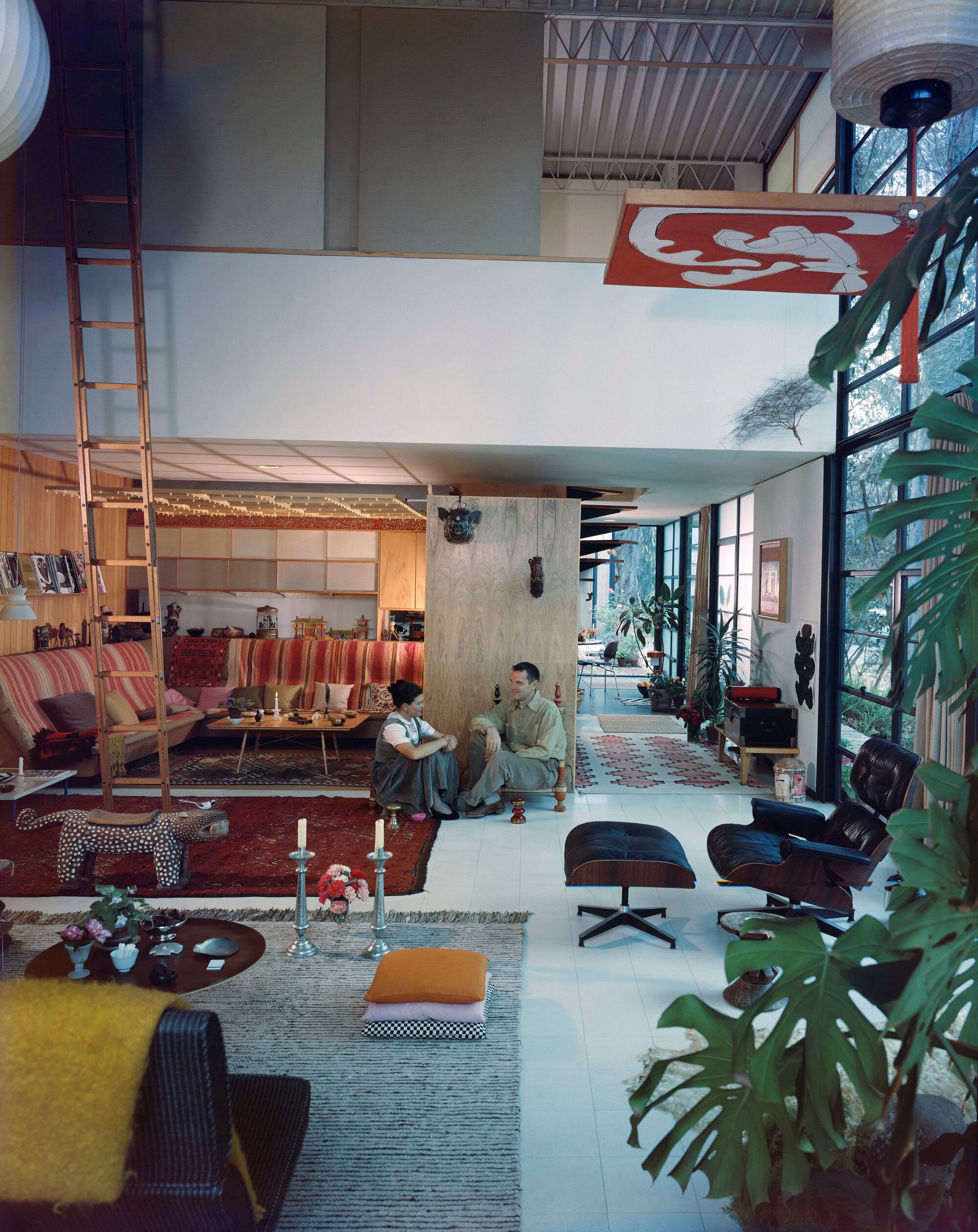
A domestic scene featuring Charles and Ray Eames presents modern informality as an inhabited, everyday space rather than an architectural manifesto. The image condenses an ideal of integrating architecture with daily life while coexisting with industrial production. The Case Study Houses program, launched in 1945 by Arts & Architecture under John Entenza, assembled prominent architects to develop residential prototypes for postwar America. The initiative responded to anticipated housing shortages after World War II and aimed to provide affordable housing for a growing middle class. It functioned as a laboratory for applying wartime technological and industrial advances to residential design. Houses used lightweight steel, standardized components, large glass surfaces, prefabricated panels, and modular systems drawn from aerospace and military industries, supported by manufacturer partnerships and mass-produced parts.
"Sitting on low benches, casually talking, dressed in comfortable clothes, and surrounded by books, design objects, and works of art, Charles and Ray Eames appear in one of the most emblematic images of postwar modern domesticity in the United States. The house does not appear as an explicit architectural manifesto, but rather as an inhabited, appropriated, everyday space. Still, nearly everything in that scene functions as the condensation of a carefully constructed ideal: modern informality, the integration between architecture and daily life with the coexistence of industrial production."
"Launched in 1945 by Arts & Architecture magazine under the direction of John Entenza, the program brought together architects such as Charles and Ray Eames, Pierre Koenig, Craig Ellwood, Eero Saarinen, and Richard Neutra around the ambition of developing residential prototypes for postwar America. The initiative emerged amid growing concerns about the housing shortage expected with the return of American soldiers after World War II, when the country faced pressure to provide affordable and rapidly deployable housing for a growing middle class."
"Functioning as a kind of laboratory to investigate how architecture could absorb the technological and industrial advances developed during the war, it proposed houses that were efficient, affordable, and quick to build. Made possible through partnerships with manufacturers and the availability of mass-produced components in the postwar context, the residences employed lightweight steel structures, standardized components, expansive glass surfaces, prefabricated panels, and modular systems originally associated with the aerospace and military industries."
Read at ArchDaily
Unable to calculate read time
Collection
[
|
...
]