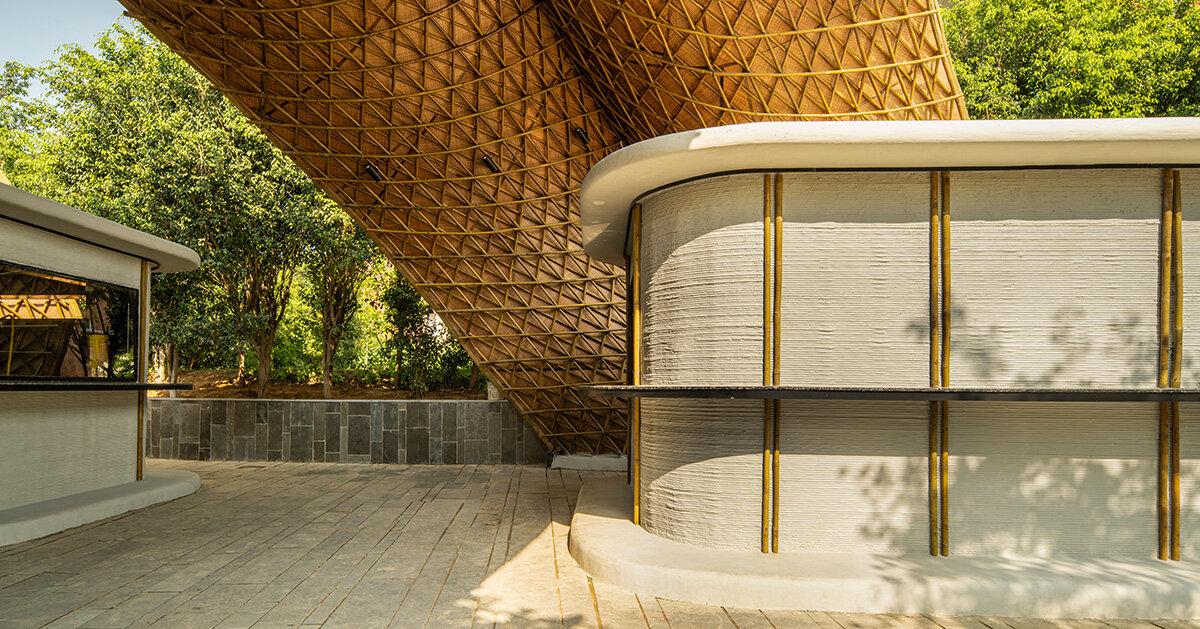
"Set beneath a dense canopy of trees in India's Ashoka University, The Hungry Caterpillar by Lyth Design rethinks the idea of a food street as a place of shelter, curiosity, and ecological responsibility. Designed by architect Apoorva Shroff, the project moves beyond the logic of fast consumption, proposing a child-friendly environment shaped by nature-inspired form, low-impact construction, and material efficiency. The concept takes shape through the simple yet evocative image of a caterpillar feeding calmly within its habitat, protected by foliage and form."
"Sustainability is embedded into Ashoka University's canteen at multiple scales, beginning with its kitchens. Inspired by food trucks, the modular cooking units are 3D printed in concrete and assembled on-site. Produced by Micob Pvt. Ltd. in Ahmedabad, the printing process uses an additive method that deposits material only where needed, reducing construction waste compared to conventional building techniques. The automated fabrication shortens construction time, lowers energy demand, while the cavity between the printed walls acts as thermal insulation, limiting heat transfer and improving energy performance."
"Overhead, Mumbai-based practice Lyth Design unifies the food street by a distinctive bamboo gridshell that gives the project its caterpillar-like identity. Drawing from natural geometries, the shading structure curves in two directions, achieving strength through form rather than mass. Like a leaf that folds efficiently toward sunlight, the bamboo shells use minimal material while spanning large distances. The longest gridshell extends 19 meters and is composed of four layers of bamboo poles, each measuring 30 to 50 millimeters in diameter"
Set beneath a dense canopy of trees at Ashoka University, the project reimagines a food street as a sheltered, curiosity-inviting, child-friendly environment. A cocoon-like bamboo gridshell references a caterpillar and uses curved natural geometries to achieve strength through form rather than mass. The longest gridshell spans 19 meters and uses four layers of bamboo poles measuring 30 to 50 millimeters. Kitchens are modular, inspired by food trucks, and 3D printed in concrete using an additive process that deposits material only where needed. The printing reduces construction waste, shortens construction time, lowers energy demand, and creates a cavity for thermal insulation.
Read at designboom | architecture & design magazine
Unable to calculate read time
Collection
[
|
...
]