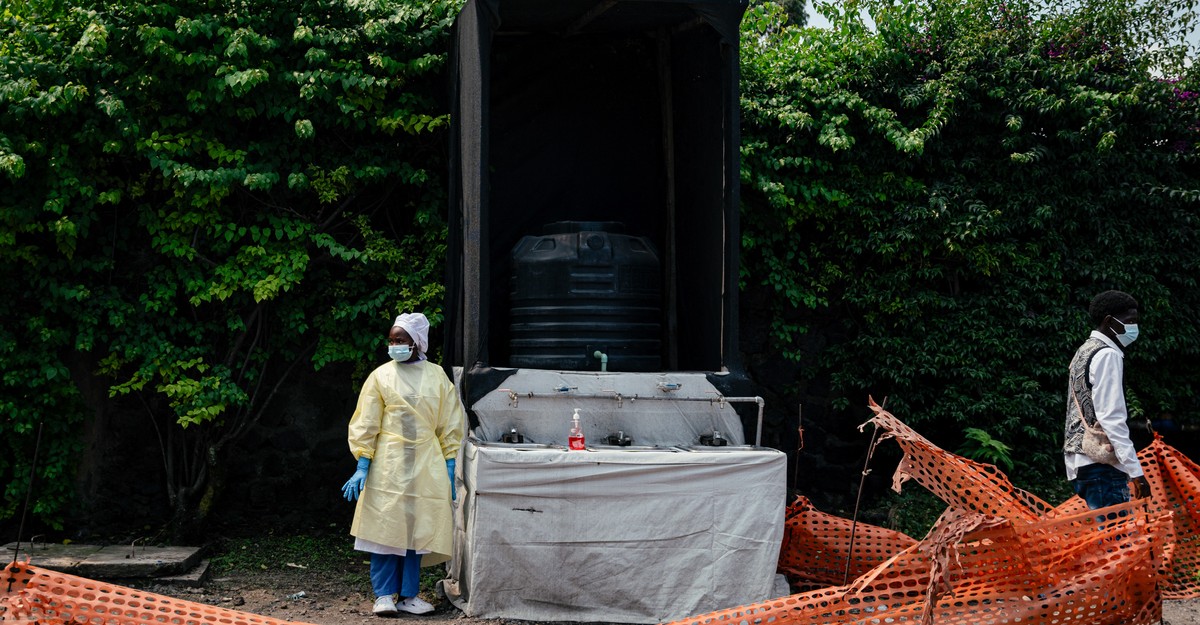
A new Ebola outbreak has been confirmed in the Democratic Republic of the Congo, with spread to Uganda. More than 500 people are suspected to be sick and more than 130 have died, suggesting the virus has been circulating largely undetected for weeks or months. The epidemic has already surpassed many prior Ebola outbreaks in size, and experts expect it to worsen before improving. The response environment is described as weaker due to recent U.S. public-health decisions, including dismantling USAID, withdrawing from the WHO, and removing infectious-disease experts from the CDC, which lacks a permanent director. The outbreak is centered on mining towns with inconsistent health care access and high movement across porous borders, creating conditions for rapid spread.
"On Friday, Africa CDC confirmed a new Ebola outbreak, centered in the Democratic Republic of the Congo; within two days, the World Health Organization declared the epidemic a public-health emergency of international concern. The virus, which has also spread to Uganda, is suspected to have sickened more than 500 people and killed more than 130-counts that suggest to experts that it has been spreading largely undetected in the region for several weeks, if not months."
"Central and West Africa have weathered dozens of Ebola outbreaks before. But this new epidemic has already surpassed most others in size, and "my projection is that it will get worse before it gets better," Nahid Bhadelia, the director of Boston University's Center on Emerging Infectious Diseases, told us. As things stand, the outbreak has already reached a point at which experts feel certain it will be very difficult to contain."
"The global-health backdrop is simply different in 2026, largely the result of a series of public-health decisions made by the United States in the past year and a half-among them, dismantling USAID, withdrawing from the WHO, and ousting infectious-disease experts en masse from the CDC, which remains without a permanent director. The world's fractured global-health community is now playing a lethal game of catch-up with an extremely dangerous virus."
"The outbreak so far centers on two mining towns-Mongbwalu and Rwampara-in a region of the DRC where access to health care is inconsistent and traffic in and out is high. During a press conference on Saturday, Jean Kaseya, the director general of Africa CDC, described the area as "very vulnerable and fragile." Relatively remote regions with high mobility and porous borders can be ideal settings for viruses to spread unnot"
#ebola #democratic-republic-of-the-congo #public-health-emergency #global-health-policy #infectious-disease-outbreak
Read at The Atlantic
Unable to calculate read time
Collection
[
|
...
]