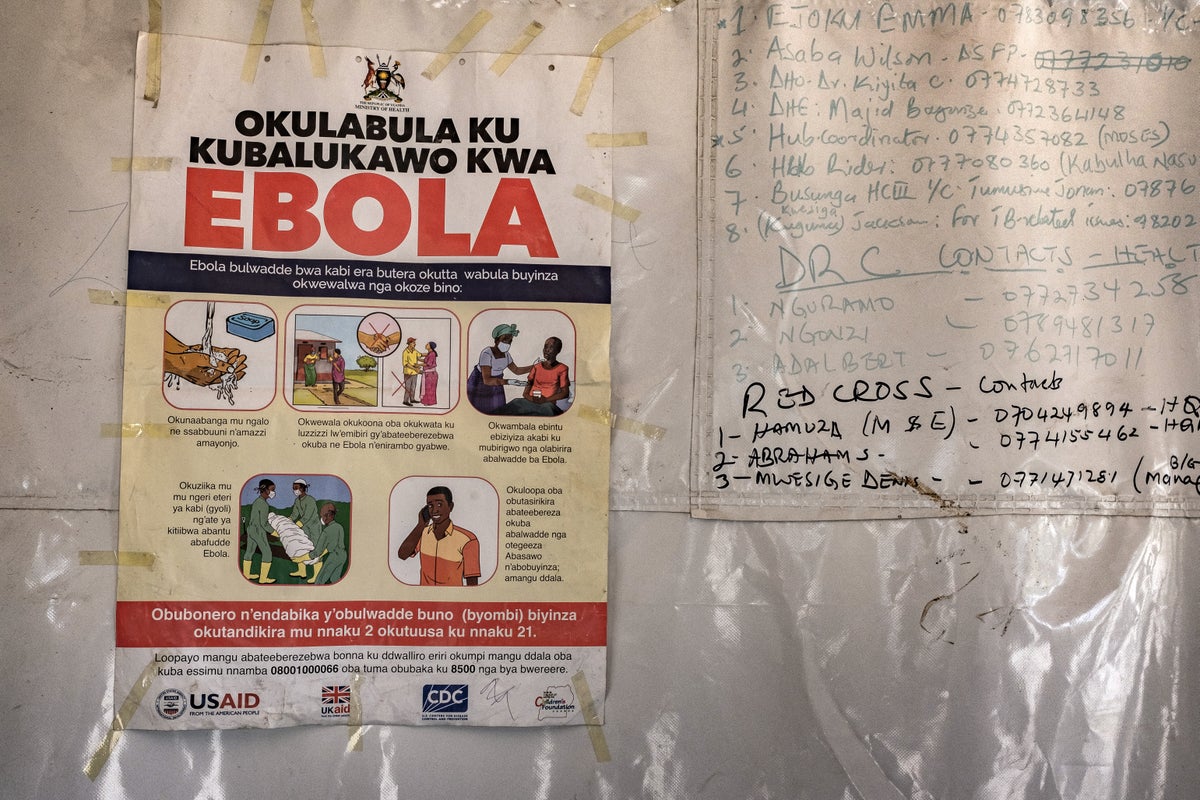
An Ebola outbreak in the Democratic Republic of the Congo and Uganda is prompting global efforts to contain Bundibugyo virus. The World Health Organization warns the virus will likely spread further and cause additional deaths beyond more than 130 estimated fatalities. Bundibugyo virus has no approved vaccine and is thought to be fatal in about 25 to 50 percent of cases, with hundreds sickened, including at least one American. WHO has declared a public health emergency of international concern due to many initial suspected cases and major uncertainties about spread. Experts stress that pandemic-level risk is low and poses minimal danger to the United States. In the DRC, cases are concentrated in a remote conflict-affected region where violence displaced more than 100,000 people, making care unsafe for health workers.
"An outbreak of Ebola in the Democratic Republic of the Congo (DRC) and Uganda has global public health officials scrambling to contain the relevant virus, which the World Health Organization (WHO) has warned will likely spread further and cause more deaths beyond the more than 130 estimated fatalities so far. This type of Ebola-causing virus, a species called Bundibugyo virus, has no approved vaccine, is thought to be fatal in about 25 to 50 percent of cases and has sickened hundreds, including at least one American."
"The WHO has declared the situation a public health emergency of international concern, citing the high number of initial suspected cases and significant uncertainties about the extent of the spread. But as serious as this outbreak is, public health experts stress that the risk of a pandemic-level threat is low, with minimal danger to the U.S. Not every pathogen has the ability to cause a pandemic, says Amesh Adalja, a senior scholar at the Johns Hopkins Center for Health Security."
"People think it's either zero or pandemic.... There are many types of public health emergencies that fall short of a pandemic that are still important. The situation in the DRC is especially acute: the first cases clustered in a remote region riven with political conflict and violence that displaced more than 100,000 people in 2025. That has made it very unsafe for health care workers to offer aid, says Jeanne Marrazzo, chief executive officer of the Infectious Disease Society of America and former director of the U.S. National Institute of Allergy and Infectious Diseases (NIAID)."
Read at www.scientificamerican.com
Unable to calculate read time
Collection
[
|
...
]