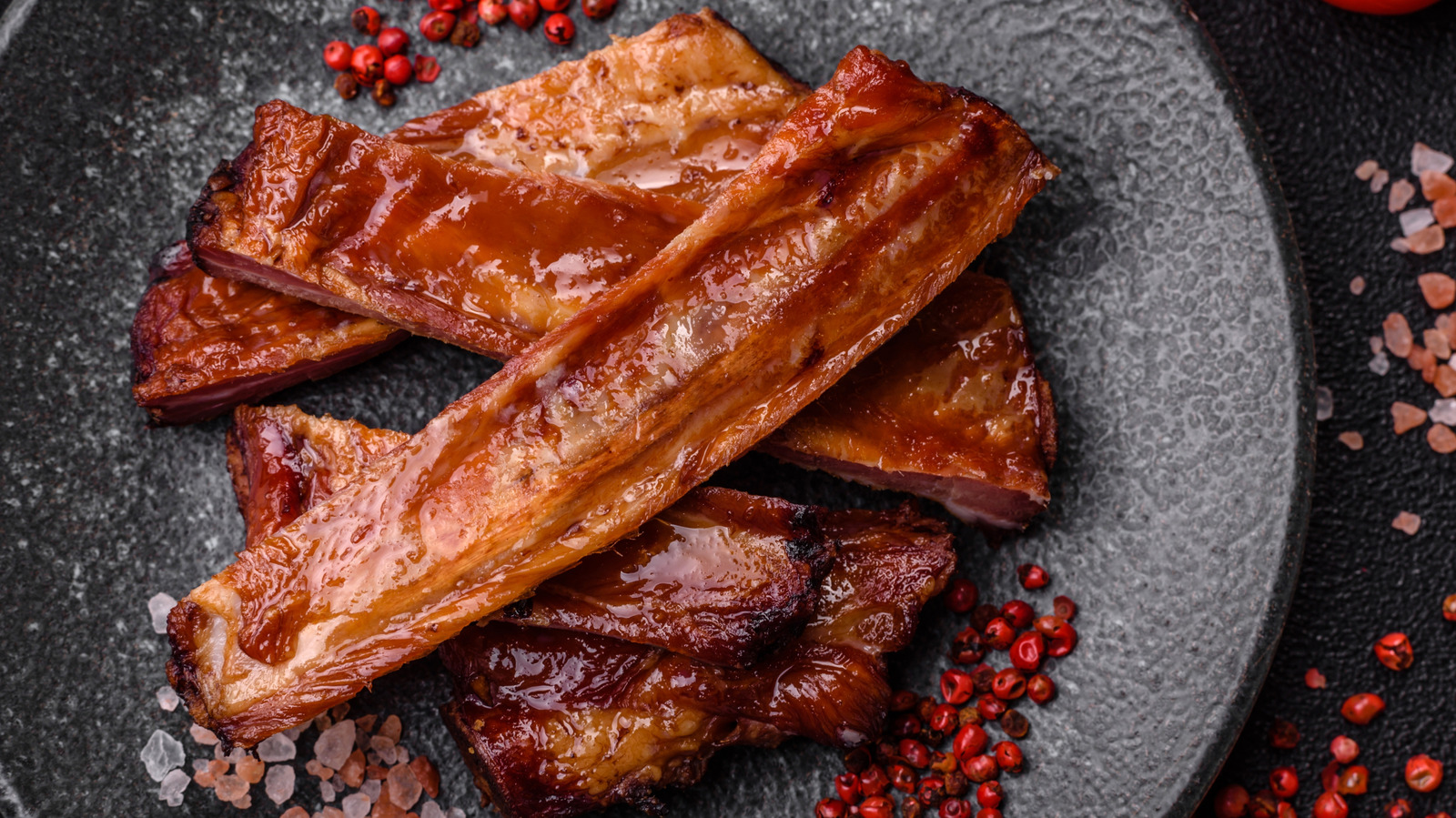
"You've heard of dinosaur-shaped frozen chicken nuggets. Now, get ready for dino ribs. These huge cuts come from the steer's plate primal section and totally dwarf baby back and short ribs (think 8-12 inches long and two pounds per individual rib). They're the beefy equivalent of the comically large, handheld turkey legs of stereotypical Medieval table spreads. On the palate, dino ribs are rich, savory, and smoky - a profile reminiscent of brisket."
"Technically, dino ribs are called "plate ribs," coming from the same region as short ribs (the plate section). More specifically, they're part of the highly-active serratus ventralis muscle in the chuck primal. This makes dino ribs meatier and fattier than back ribs, an ideal fit for slow-cooking, long-smoking, and braising. As their generous fat ripples melt, that hearty, rich, well-marbled beef becomes ultra-tender when cooked for long enough to break down the tough connective muscular tissue."
Dino ribs are large beef plate ribs from the steer's plate primal, often 8–12 inches long and weighing about two pounds per rib. They come from the serratus ventralis muscle in the chuck primal, making them meatier and fattier than back ribs. The meat is rich, savory, smoky, and reminiscent of brisket as fat and marbling render during long cooking. Whole racks are typically dry-rubbed, rested, then slow-cooked: 6–8 hours on a smoker at 225°F, 2–3 hours on a grill, or 3–4 hours in an oven, with finished temperature around 200°F. Dino ribs often require special ordering from a butcher.
Read at Tasting Table
Unable to calculate read time
Collection
[
|
...
]