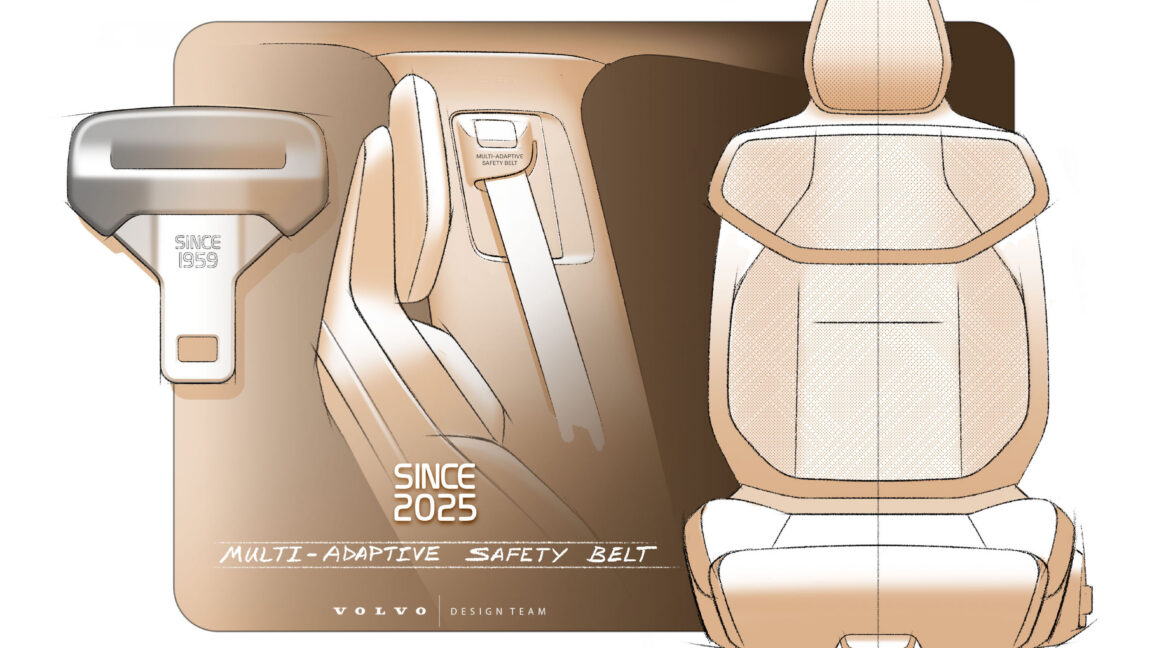
"Basically, a seat belt is made up of a retractor mechanism, buckle assembly, webbing material, and a pretensioner device. Of these parts, the pretensioner is the one tasked with tightening the seatbelt webbing in a collision. As such, it reduces the forward movement of the passenger before the airbag deploys at speeds of up to 200 mph (321 km/h). All of these parts remain the same for Volvo's newest seat belt iteration. It's the tiny brain attached to the assemblage that's different."
"Volvo's new central computing system, HuginCore (named after a bird in Norse mythology), runs the EX60 with more than 250 trillion operations per second. It has been developed in-house, together with its partners Google, Nvidia, and Qualcomm. "With the HuginCore system we can collect a lot of data and make decisions in the car instantly and combine that with the belt's ability to choose different load levels,""
Volvo integrated a high-performance central computer, HuginCore, to add intelligent control to seat belt pretensioners. The system processes sensor data at over 250 trillion operations per second and was developed with Google, Nvidia, and Qualcomm. The pretensioner can now choose from 11 load-limiting profiles instead of three, enabling more precise belt forces tailored to crash type and occupant characteristics. Millisecond-scale decisions use exterior, interior, and crash sensors to hold the hips while allowing controlled upper-body motion so the body meets the airbag smoothly. The result reduces forward movement and improves occupant kinematics to lower injury risk.
Read at Ars Technica
Unable to calculate read time
Collection
[
|
...
]