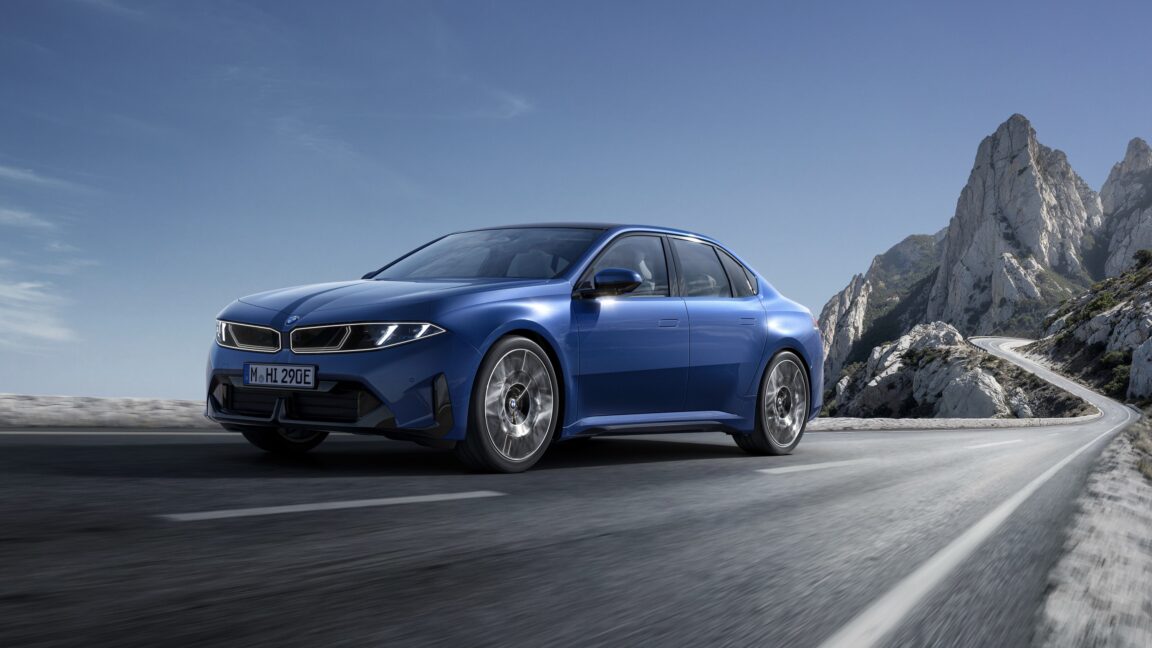
The BMW i3 utilizes the company's 6th-generation powertrain with an 800V battery pack containing cylindrical cells that are 20% more energy-dense than previous prismatic cells. The cell-to-pack design further enhances energy density, enabling 400 kW DC fast-charging and up to 440 miles of range—a 30% improvement over 5th-generation EVs. The i3 50 xDrive combines front and rear motors producing 463 hp and 476 lb-ft of torque with 40% lower energy losses, 10% lighter weight, and 20% lower manufacturing costs. The vehicle incorporates 30% recycled materials and mono-material construction for easier recycling, achieving carbon parity with gasoline models in approximately one year. Engineering prioritizes driving dynamics with near 50:50 weight distribution, low center of gravity, optimized suspension tuning, and rear-biased torque delivery.
"At the core of the car is its 800 V battery pack, which uses new cylindrical cells that are 20 percent more energy-dense by volume than the prismatic cells you'd find in one of BMW's 5th-gen EVs like the i4. The cell-to-pack design further increases the energy density of the pack compared to the previous generation. It's able to DC fast-charge at up to 400 kW, and BMW is predicting up to 440 miles (708 km) of range, a 30 percent improvement on its 5th-gen EVs."
"BMW says that energy losses are 40 percent lower than its 5th-gen powertrain, as well as being 10 percent lighter and 20 percent cheaper to make. The whole thing is a lot more sustainable, too. It uses about 30 percent recycled materials, and there's a greater use of mono materials to make recycling much easier at the car's end of life."
"Weight distribution is close to 50:50, with a low center of gravity thanks to the battery pack. It has softer springs than the iX3 for better ride comfort, with less-stiff top-mount bushings, different stiffnesses for the antiroll bars, and a stiffer connection to the rear wheel carriers."
Read at Ars Technica
Unable to calculate read time
Collection
[
|
...
]