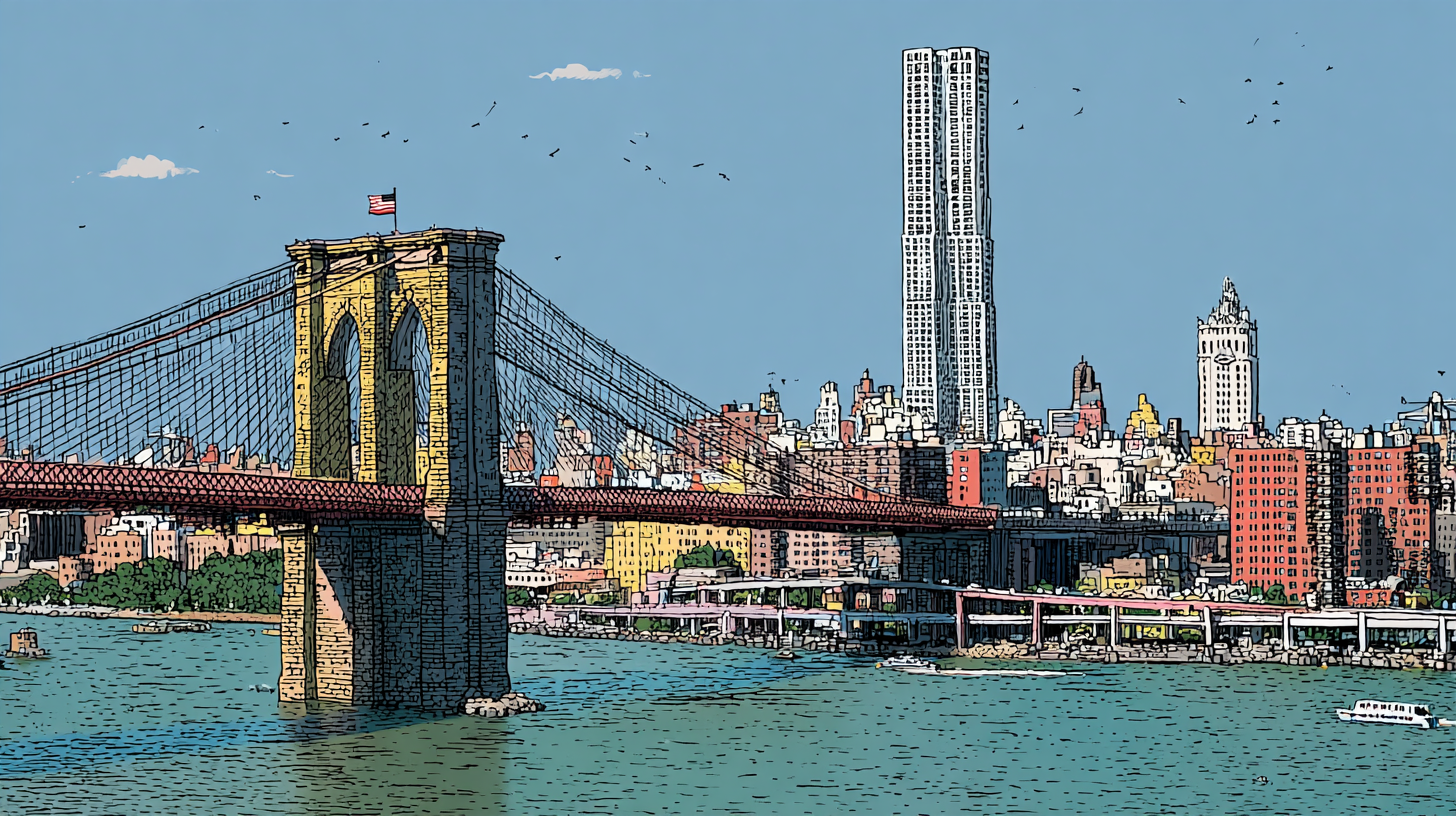
The Brooklyn Bridge stands as one of the greatest achievements of 19th-century American capitalism. Engineer John Roebling, a German immigrant who arrived in the US in 1831 seeking freedom, conceived the bridge after experiencing ice-caused delays crossing the East River. Roebling became a self-made millionaire through his New Jersey wire rope manufacturing factory. Known for his relentless work ethic, innovative thinking, and unwavering determination, he never took days off and regarded illness as a moral offense. His indomitable confidence and conviction that no circumstance could divert him from his projects drove the bridge's ambitious construction, comparable to other major 19th-century American achievements like the transatlantic telegraph cable and the Great Northern Railroad.
"In all his working life John Roebling had never been known to take a day off... he was never known to give in or own himself beaten... illness he regarded as a moral offense and he fought it with the same severe intensity he devoted to everything else... He was an inventor as well as an engineer who had designed every apparatus in his factory."
"Roebling (1806-1869) emigrated from Germany to the US in 1831, seeking greater freedom than in his homeland. According to historian David McCullough in The Great Bridge: The Epic Story of the Building of the Brooklyn Bridge, Roebling was a man undaunted even by the most imposing impediments. He was a brilliant entrepreneur: a self-made millionaire in the mid-19th century from profits earned by his New Jersey factory manufacturing wire rope."
Read at Foundation for Economic Education
Unable to calculate read time
Collection
[
|
...
]