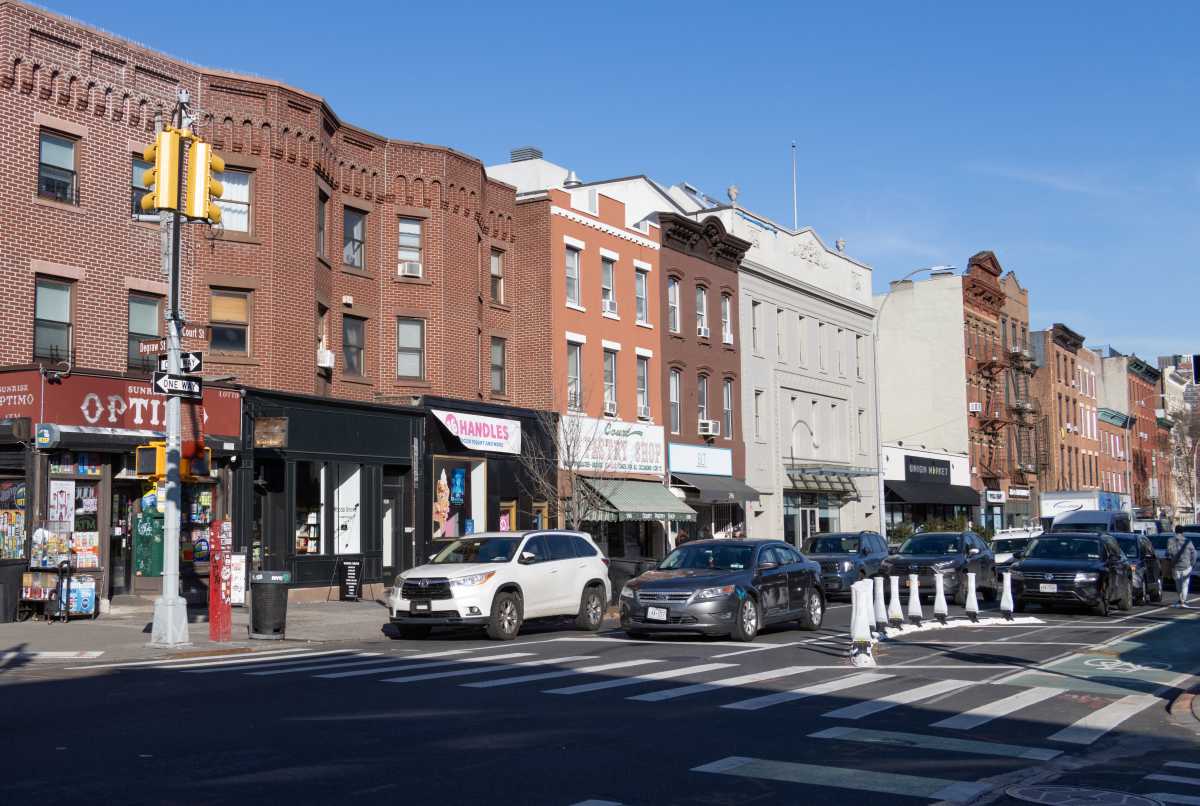
A judge dismissed the legal challenge to the Court Street parking-protected bike lane, finding a rational basis for the change and noting opponents offered no factual evidence. The DOT installed the protected lane last fall and removed a vehicle traffic lane along a 1.3-mile stretch from Schermerhorn Street to Hamilton Avenue. DOT cited a disproportionately high number of deaths and injuries on the roadway as the primary motivation. Between 2020 and 2024, 155 people were injured and two were killed on that section. Crash analysis found fast turns and double-parking reduced visibility and produced sideswipes, prompting the redesign to reduce double parking, improve intersections, and create dedicated space for cyclists and pedestrians. A merchants association sued seeking to restore the prior configuration, alleging regulatory noncompliance.
"In her decision, Brooklyn Supreme Court Justice Inga M. O'Neale said that a "rational basis" for installing the lane and that its opponents failed to provide factual evidence to back up their arguments against it. The Department of Transportation installed the parking-protected bike lane and removed a vehicle traffic lane on a 1.3-mile stretch of Court Street, from Schermerhorn Street to Hamilton Avenue, last fall."
"In court documents, DOT Director of Safety Projects Chris Brunson said the "primary motivation" for the project was the "disproportionately high number of deaths and injuries" reported along the roadway. Between 2020 and 2024, 155 people were injured in crashes along the section of Court Street in question and two were killed, according to agency data."
"Crash patterns indicated that most injuries were caused by drivers taking "fast and aggressive turns" and showed that double-parking was reducing visibility and causing drivers and cyclists to weave in and out of traffic, causing a much higher than average number of sideswipes. The redesign was meant to cut down on double parking, improve safety at intersections, and create "dedicated space" for cyclists and pedestrians on Court Street, the documents state."
Read at Brooklyn Paper
Unable to calculate read time
Collection
[
|
...
]