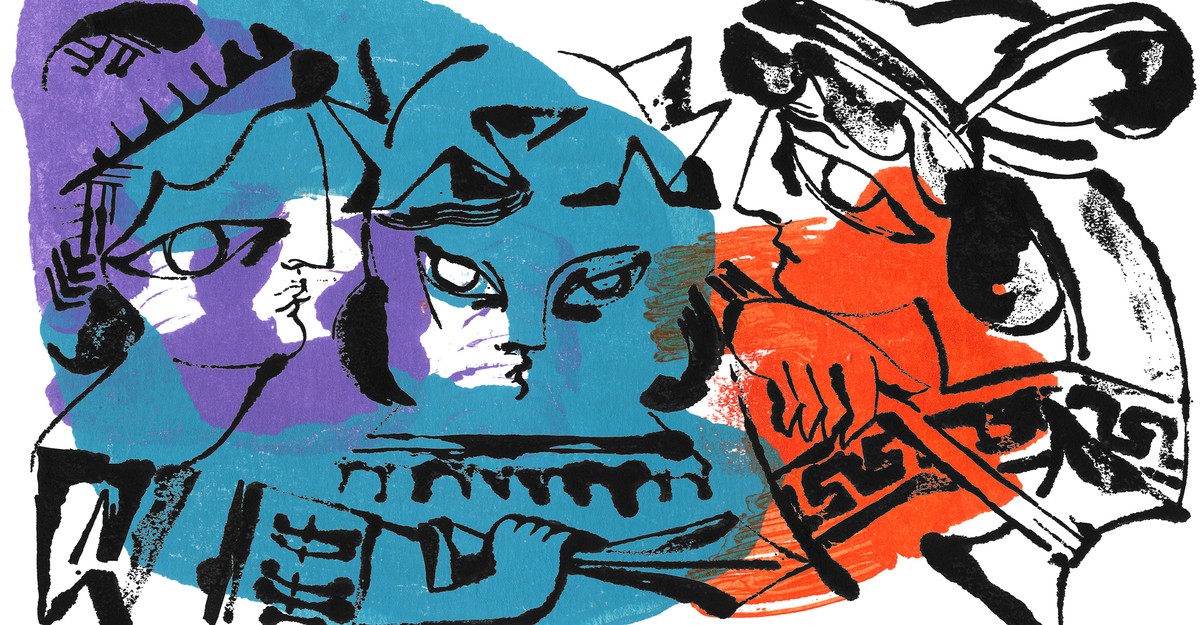
"When I was 8 or 9 years old, my uncle and aunt gave me a copy of D'Aulaires' Book of Greek Myths, a standard-bearer for children's folklore that was originally published in 1962. I was immediately dazzled by the book: D'Aulaires' was my first exposure to Greek mythology, and I marveled at its vibrant cosmology, its richly illustrated tales of deities whose omnipotence was matched only by their strikingly human, self-indulgent caprice."
"Over the years, I committed to memory the elaborate organizing logic of Greek antiquity. The immortal residents of Mount Olympus-philandering Zeus and his cascading (sometimes circular) family tree-governed every aspect of human existence. I was daunted by such a deterministic universe, in which the free will of mortals counted for so little. Yet I was compelled, even comforted, by the coherence of this worldview, in which one's life was entirely foretold."
"The Greek writer Kay Cicellis, who died in 2001, might have shuddered at such a sunny view of fate. One year before Ingri and Edgar Parin D'Aulaire published their compendium of Greek myths, Cicellis released her second work of fiction, The Way to Colonos, which ruthlessly dramatizes the limits of individual freedom and the agony of facing one's powerlessness. The book has recently been reissued at what feels like a propitious moment, when modern treatments of Greek myth proliferate,"
A childhood encounter with D'Aulaires' Book of Greek Myths produced wonder at a vibrant cosmology and a deterministic worldview in which gods' omnipotence governed human lives. The Way to Colonos transforms Greek myth into three mid-20th-century Greek stories that parallel Sophoclean tragedies, brutally dramatizing limitations of individual freedom and the agony of confronting powerlessness. The retellings reframe Oedipus at Colonos, Electra, and Philoctetes as modern narratives that juxtapose ancient destiny against contemporary experience. A recent reissue arrives amid a resurgence of modern myth adaptations that reinterpret themes of destiny and order for a more chaotic, individualistic era.
Read at The Atlantic
Unable to calculate read time
Collection
[
|
...
]