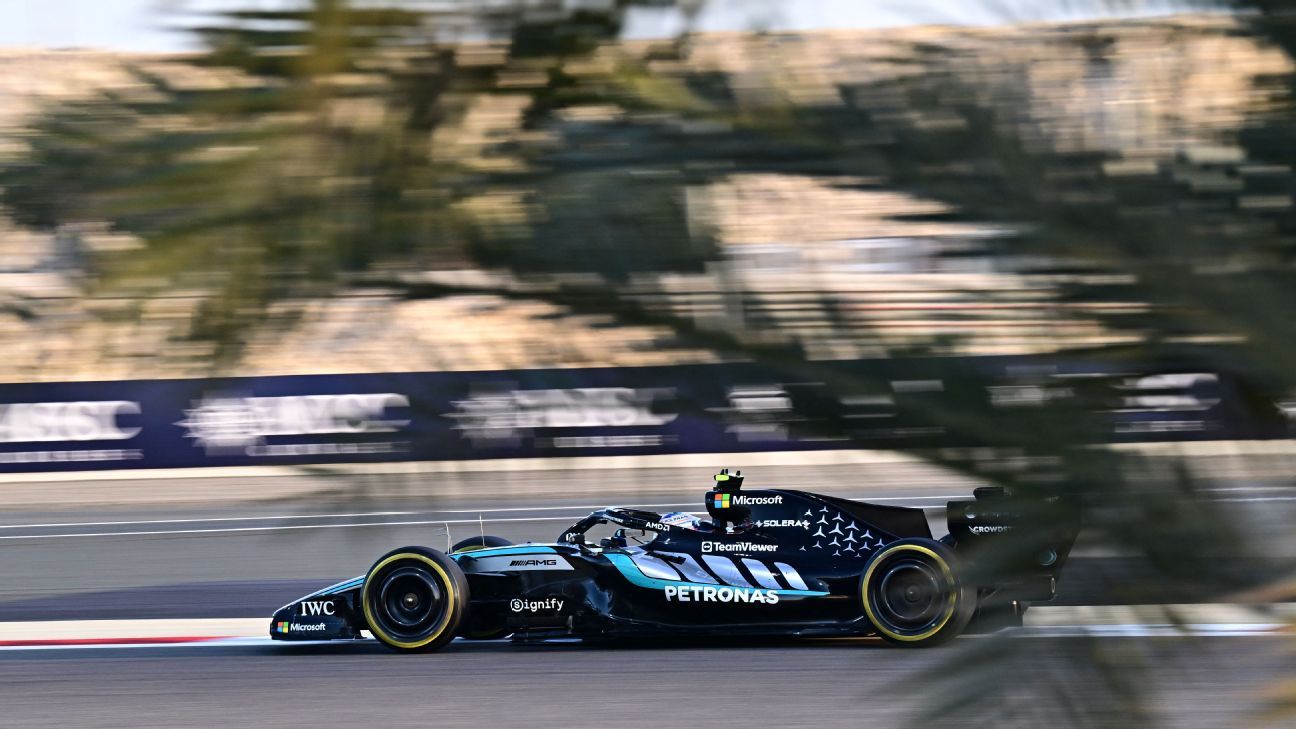
"All that's left to do is wait for Australia. From the shakedown in Barcelona to two three-day tests in Bahrain, Formula 1's preseason program has come and gone, and the next time the field will take to the track will be on March 5 in Melbourne. Before we get to Albert Park, though, ESPN has pored over the lap charts and spoken to sources up and down the pit lane."
"One noticeable factor in Mercedes' single-lap running was consistently slower top speeds on the pit straight as they started the lap. On his fastest lap on Friday, for example, George Russell was 8 kph slower than Leclerc, meaning he had already sacrificed 0.2s of lap time to the Ferrari by the time he hit the brakes for Turn 1. Russell also lifted and coasted on the approach to Turns 4, 11 and 14 when his fastest lap is compared to those of his main rivals."
"That could be a quirk of how the Mercedes power unit harvests and deploys its battery power around the lap, but a comparison with Lando Norris' Mercedes-powered McLaren suggests higher top speeds on the pit straight and less lifting and coasting into corners are very possible. More likely, a large proportion of Russell's 1.2-second gap to Leclerc on Friday can be explained by Mercedes running a less aggressive energy-deployment strategy for its fastest lap."
Preseason testing included a shakedown in Barcelona and two three-day tests in Bahrain ahead of the March 5 season opener in Melbourne. Kimi Antonelli set Mercedes' fastest time of the week at 1:32.803 while George Russell recorded consistent race-pace. Mercedes exhibited consistently lower top speeds on the pit straight and tended to lift and coast into several corners on single-lap runs. Comparisons with Lando Norris' Mercedes-powered McLaren indicate higher pit-straight speeds and less lifting are achievable. A less aggressive energy-deployment strategy likely accounts for much of Mercedes' single-lap deficit to Ferrari.
Read at ESPN.com
Unable to calculate read time
Collection
[
|
...
]