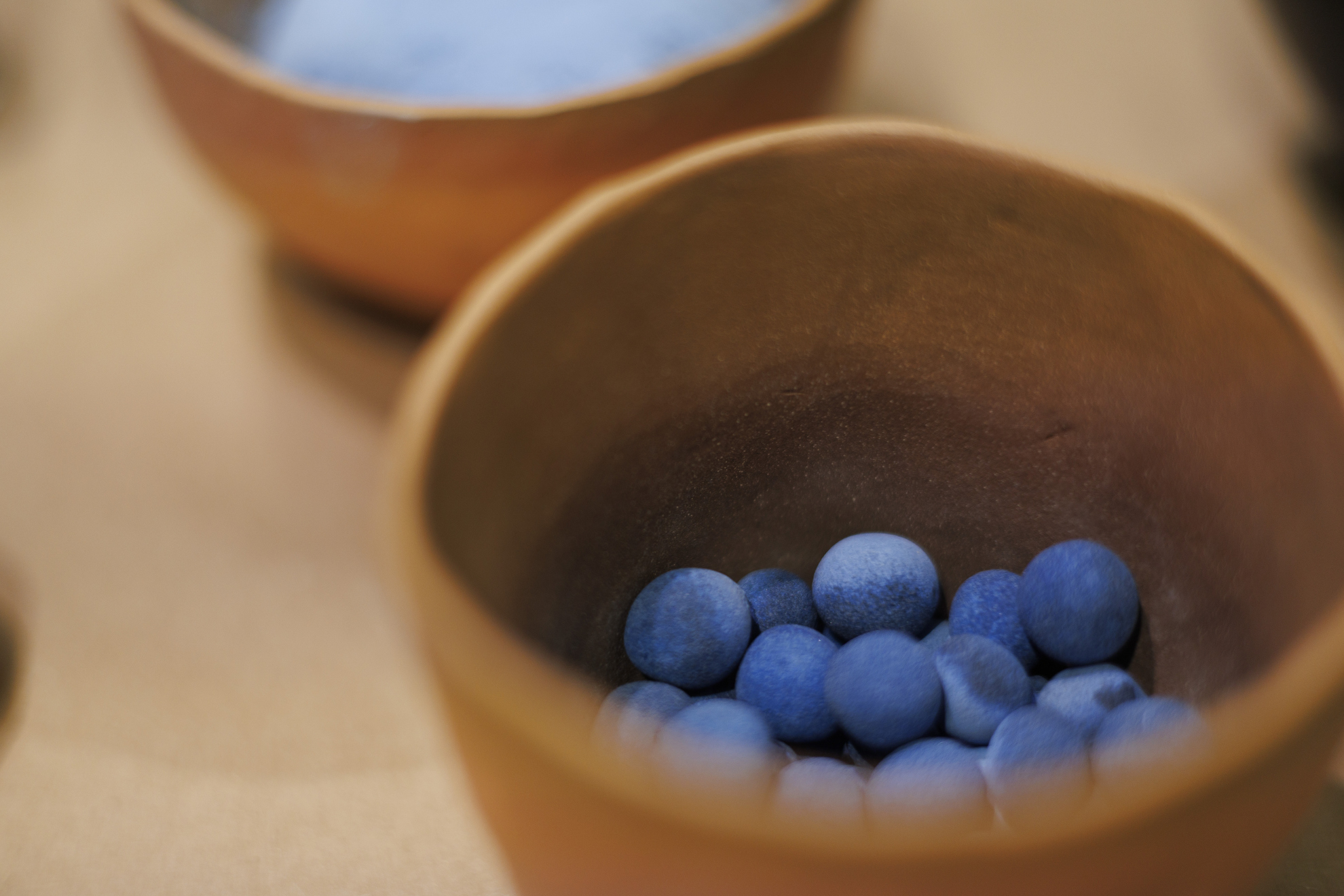
""Pigments are everywhere. You can find them in dry media, like pastels, crayons. They're in papers, they're in photographs, they can be in plastics," said Lisa Barro '97, an adjunct professor in art history at NYU, who helped lead the workshop. "Egyptian blue was the earliest synthetic pigment, made around 3100 B.C.""
"The vibrant blue was the product of advances in Egyptian pyrotechnology that allowed silica, copper, calcium, and sodium salt to be combined at a high heat. It was a cheaper alternative to rare, mined lapis lazuli and went on to become a favorite among artists for centuries."
"During the workshop Barro, along with conservator Carolyn Riccardelli of the Metropolitan Museum of Art, utilized a novel technique known as visible-induced luminescence imaging, or VIL. This is how it works: Researchers examine a piece illuminated by visible light using a device equipped with infrared detection technology."
"Areas containing Egyptian blue appear to be almost glowing amid the otherwise black-and-white VIL image. "So if you use a put a special filter on your camera, to block the reflected visible light, you can see this.""
Egyptian blue, synthesized around 3100 B.C. by ancient Egyptians, marked a significant advancement in pigment creation. This vibrant blue pigment was made from silica, copper, calcium, and sodium salt, providing a cost-effective alternative to lapis lazuli. A recent workshop at Harvard Art Museums demonstrated the creation of Egyptian blue and its legacy. Conservationists utilized visible-induced luminescence imaging to identify this pigment in artworks, showcasing its historical importance and widespread use in various media.
Read at Harvard Gazette
Unable to calculate read time
Collection
[
|
...
]