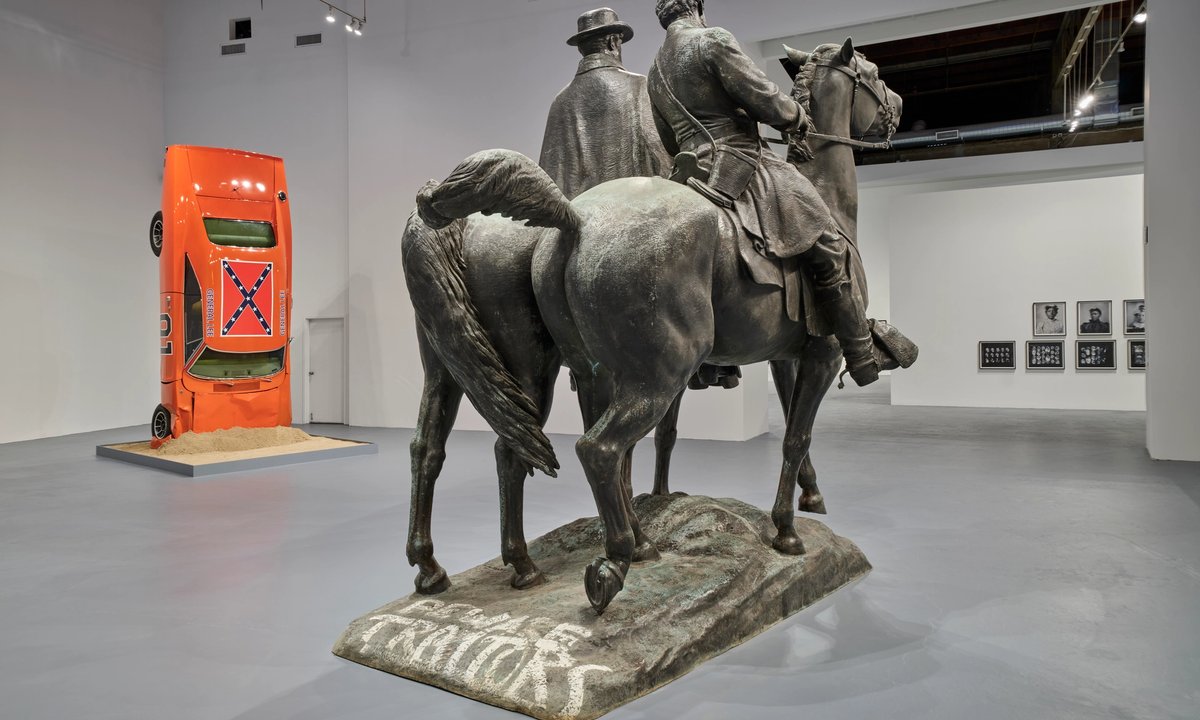
"The original statue, and an even larger monument to the Confederate general Robert E. Lee nearby, had long stood in Charlottesville, Virginia. But fuelled by community outrage, the city council voted to remove them in 2017, triggering a deadly neo-Nazi rally there that summer. A few years and lawsuits later, the statue came down, and the Monuments co-curators-Hamza Walker of the Brick and Bennett Simpson at Moca-offered it to Kara Walker."
"She opted to turn the patinated bronze and heroic vocabulary of the sculpture against itself, exposing the grotesque underpinnings of Confederate history and present-day Lost Cause ideology, which romanticises the South's battle as a valiant fight for state rights. The New Yorker magazine's Julian Lucas rightly called the work "at once an act of carnivalesque retribution and a recognition of the Confederacy's zombie-like persistence"."
"The work, titled Unmanned Drone (2023), is so ambitious that it occupies its own venue, The Brick, while all other works are displayed at the Geffen branch of the Museum of Contemporary Art (Moca). And it represents one way-certainly the most hands-on-of responding to the hotly politicised removal of Confederate monuments that has in recent years impacted US cities from Baltimore to Montgomery."
Kara Walker reworked a massive Confederate equestrian statue of Stonewall Jackson into Unmanned Drone (2023), dismembering the horse, beheading Jackson and severing limbs to create a Frankenstein-like figure. The altered monument occupies The Brick while other works appear at the Geffen branch of MOCA, with Walker credited as co-curator. The original statues in Charlottesville were removed after community protest and a deadly 2017 neo‑Nazi rally. The reconfigured bronze uses heroic monument language against itself to reveal grotesque underpinnings of Confederate history and the persistence of Lost Cause ideology, framing the removal and reinterpretation of public memorials.
Read at The Art Newspaper - International art news and events
Unable to calculate read time
Collection
[
|
...
]