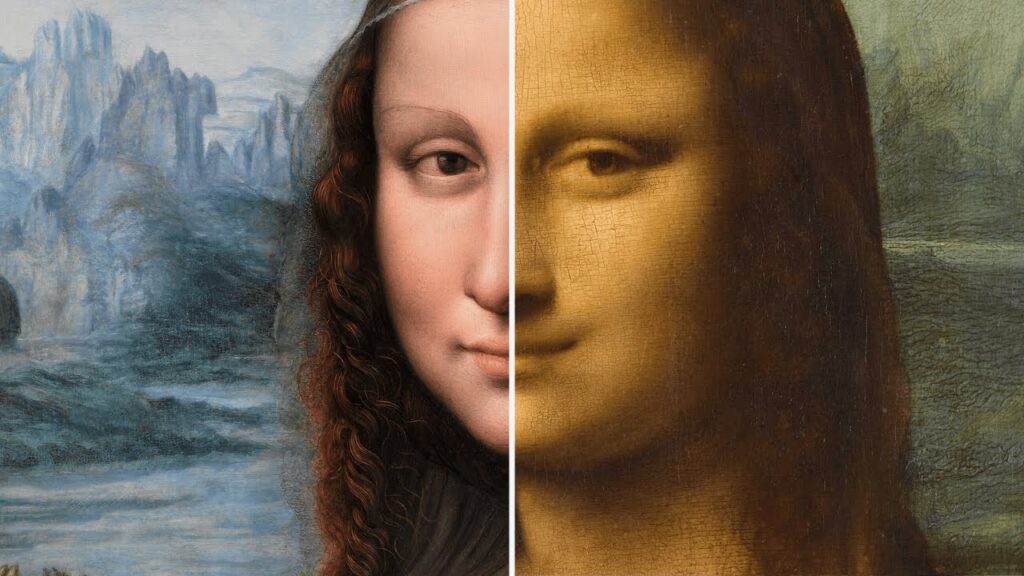
"Infrared pho­tog­ra­phy has even revealed, says the nar­ra­tor of the new Inspi­rag­gio video above, that both paint­ings "share the same changes in the orig­i­nal sketch. For years, it has been known that Leonar­do made small cor­rec­tions to the shape of the Mona Lisa 's hands, adjust­ments to the line of the eyes, and sub­tle mod­i­fi­ca­tions to the curve of the face," the very same cor­rec­tions that were found in the new­ly exam­ined copy."
"Unlike oth­er copies, the Prado's ver­sion uses "incred­i­bly expen­sive pig­ments" such as lapis lazuli-imported from Afghanistan-for the sky. This only became evi­dent dur­ing the 2012 restora­tion, when the back­ground, long hid­den under a thick lay­er of black, was final­ly uncov­ered. There­after, the Pra­do Mona Lisa was exhib­it­ed along­side the Mona Lisa at the Lou­vre in a tem­po­rary exhi­bi­tion."
The Prado Mona Lisa likely dates to the same period as Leonardo’s original and may have been painted by one of his students. Infrared photography reveals identical changes in the underdrawing of both paintings, including corrections to the hands, eye lines, and facial curve. The Prado version retains brighter colors and fine details that the Louvre version has lost. Expensive pigments such as lapis lazuli were used in the Prado sky, uncovered during a 2012 restoration when a darkened background was removed. The Prado and Louvre paintings were later shown together in a temporary exhibition.
Read at Open Culture
Unable to calculate read time
Collection
[
|
...
]