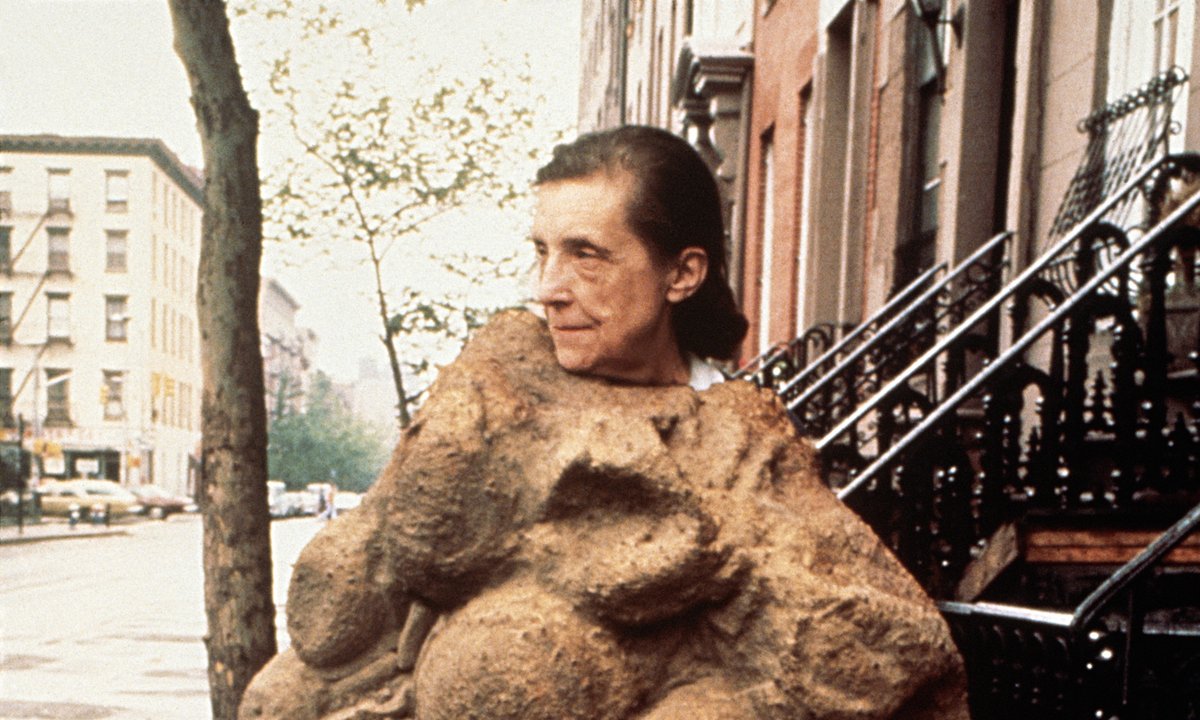
"A famous portrait of the French-American artist Louise Bourgeois (1911-2010) shows her outside her home in New York City, wearing one of her latex sculptures, Avenza (1968-69), named after a village in Tuscany. Wrapped in a cocoon of breast-like half-cups, she looks like a rumpled mother goddess who has been accidentally teleported to Chelsea in New York: the Ephesian Artemis, for example, usually portrayed with similar appendages covering her upper torso."
"Strikingly, Bourgeois, her hair pulled back, looks away from the camera, as if hoping to distance herself from her own daring: a schoolmarm pushed to play the role of iconoclast. In her richly detailed Knife-Woman: The Life of Louise Bourgeois, wonderfully translated from the French by Lauren Elkin, the art historian and curator Marie-Laure Bernadac suggests that such ambivalence is in fact characteristic of her subject's work as a whole."
Louise Bourgeois, born in Paris on Christmas Day three years before the First World War, repeatedly revisited the traumas of her childhood. Her father Louis, owner of a fine-tapestry gallery, returned from war a philanderer and bully who carried on an affair with the family’s British nanny and mocked his daughter by carving an orange peel into a girl while proclaiming, "Louise has nothing there." Bourgeois translated complex familial pain into a career of sexually ambiguous figures and installations shown worldwide. She both avenged paternal cruelty and celebrated her mother Joséphine, a weaver and seamstress, through towering spider sculptures such as Maman (1999). A famous portrait captures her wearing the latex Avenza, blending maternal and iconoclastic imagery.
Read at The Art Newspaper - International art news and events
Unable to calculate read time
Collection
[
|
...
]