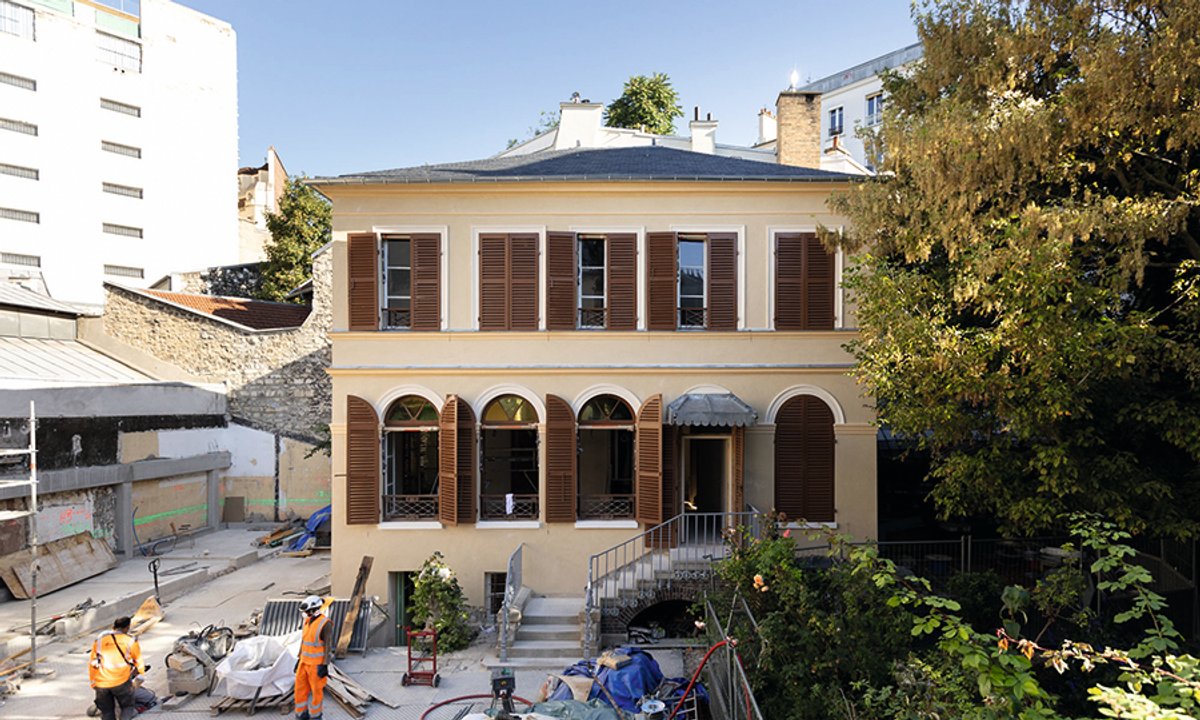
"The Musée de la Vie romantique, in the former home and studios of the Dutch-French painter Ary Scheffer (1795-1858), reopens this month after a €3.8m renovation funded by the city of Paris and private donors who contributed to a fundraising campaign. The house was built in 1830, then rented by Scheffer, who extended it. In 1956, it was transferred to the French state and opened as a museum in 1982, initially as an annex of the Musée Carnavalet. It welcomed 230,000 visitors in 2023 before closing for the refit the following year."
"The refurbishment, carried out by Basalt Architecture, focused on the timber framework, roof and façades, restored using lime in accordance with traditional 19th-century techniques. Joinery and window frames were also restored. The green shutters-repainted in various colours over the years-have been returned to their original beige-brown. Gaëlle Rio, the museum's director, says they now match the way Arie Johannes Lamme, Scheffer's cousin, depicted them in Ary Scheffer at Work in the Large Studio at His House, Rue Chaptal in Paris, a painting held by the Dordrechts Museum in the Netherlands."
"Under the guidance of Àkiko design studio, the exhibition has also been fully renewed. Of around 2,340 works in the collection, 300 will be on display, including 70 recently restored works-among them, Scheffer's Faust in his Studio (1831). A film about the site's history greets visitors in the former reception area, while the ticket office, shop and cloakroom have been brought together into former workspaces in the courtyard. Access has been improved through the resurfacing of pathways, and a new path connects the garden to the restaurant in the museum's greenhouse."
The Musée de la Vie romantique reopens following a €3.8m renovation funded by the city of Paris and private donors. The house, built in 1830 and extended by Ary Scheffer, was transferred to the French state in 1956 and opened as a museum in 1982 as an annex of the Musée Carnavalet. Basalt Architecture restored timber framework, roof and façades using lime and 19th-century techniques, and repaired joinery and window frames. The green shutters were returned to their original beige-brown. Under Àkiko design studio, the exhibition has been renewed: 300 of about 2,340 works will be displayed, including 70 recently restored pieces. Visitor facilities, pathways and a route to the greenhouse restaurant were improved, and multimedia elements were added to the visitor route.
Read at The Art Newspaper - International art news and events
Unable to calculate read time
Collection
[
|
...
]