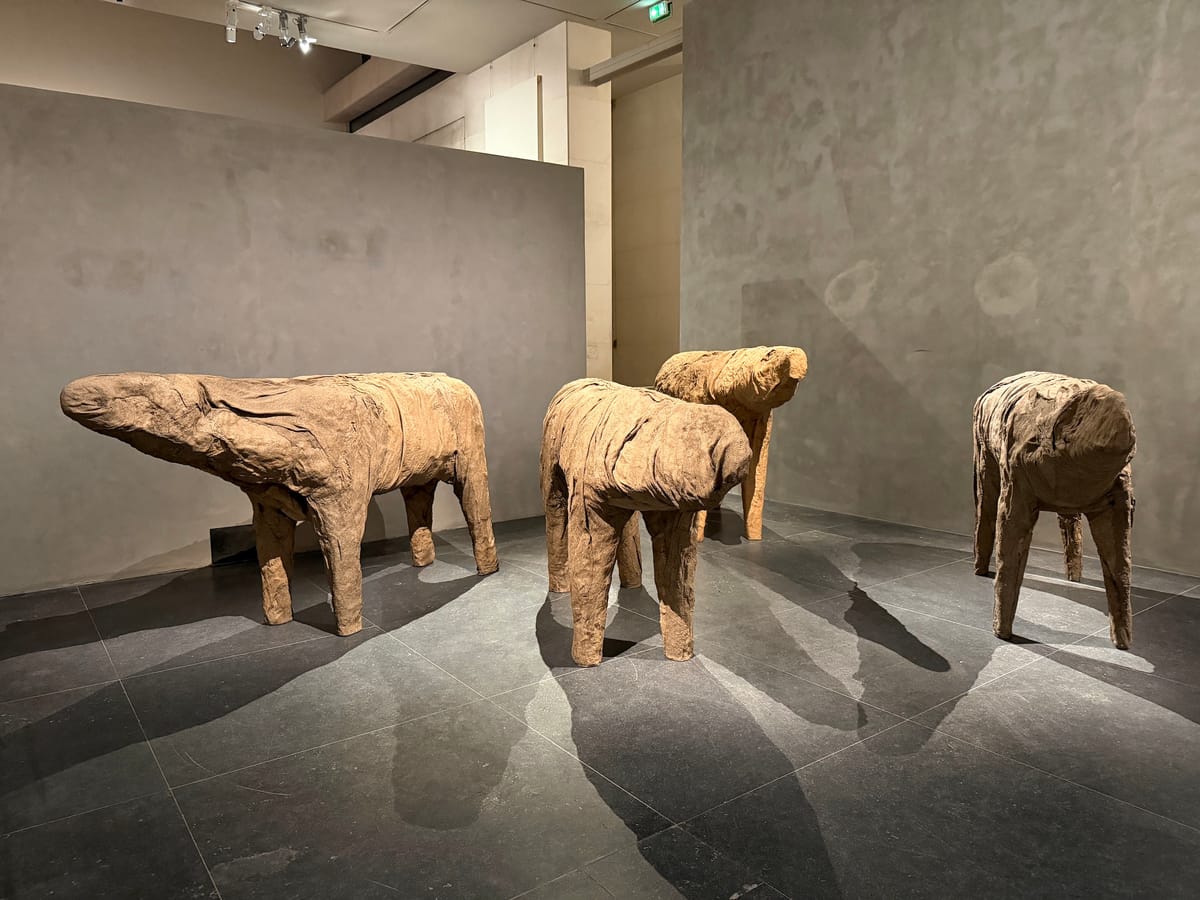
"The organicity of the human body we're born inside of is encoded in us. This concept of our organic nature as the source of elemental knowledge, at once direct and mysterious, permeates the textural abstractions exhibited in her survey Magdalena Abakanowicz: The Thread of Existence at Musée Bourdelle."
"She belonged to the Eastern European arts vanguard, alongside figures in Poland such as Tadeusz Kantor and Jerzy Grotowski, whose mysticism opposed the socialist ideology seeking to submit the collective body to industrial productivity. The artists saw the body as imbued with spiritual vitality instead, unbowed to the idea of progress imposed by industrialized modernity."
"Her sculptures, or "abakans," as she nicknamed them, bring to mind decorative gobelins seen in Polish homes. Yet unlike the humble domestic adornments, the giant abakans at Bourdelle convey earthiness, and eroticism through their natural fibers and basic shapes."
Magdalena Abakanowicz's survey at Musée Bourdelle in Paris showcases approximately 80 works spanning textiles, sculptures, and drawings from the 1960s through early 2000s. Originally censored in Communist Poland for formalism, her work gained international recognition through major exhibitions including the Lausanne Tapestry Biennials and Venice Biennale. Abakanowicz belonged to the Eastern European arts vanguard, opposing socialist ideology by emphasizing spiritual vitality within the body rather than industrial productivity. Her distinctive sculptures, called "abakans," draw inspiration from traditional Polish domestic textiles but transcend humble origins through earthiness and eroticism. Using natural fibers and basic shapes, these works embody organic human nature as a source of elemental knowledge.
Read at Hyperallergic
Unable to calculate read time
Collection
[
|
...
]