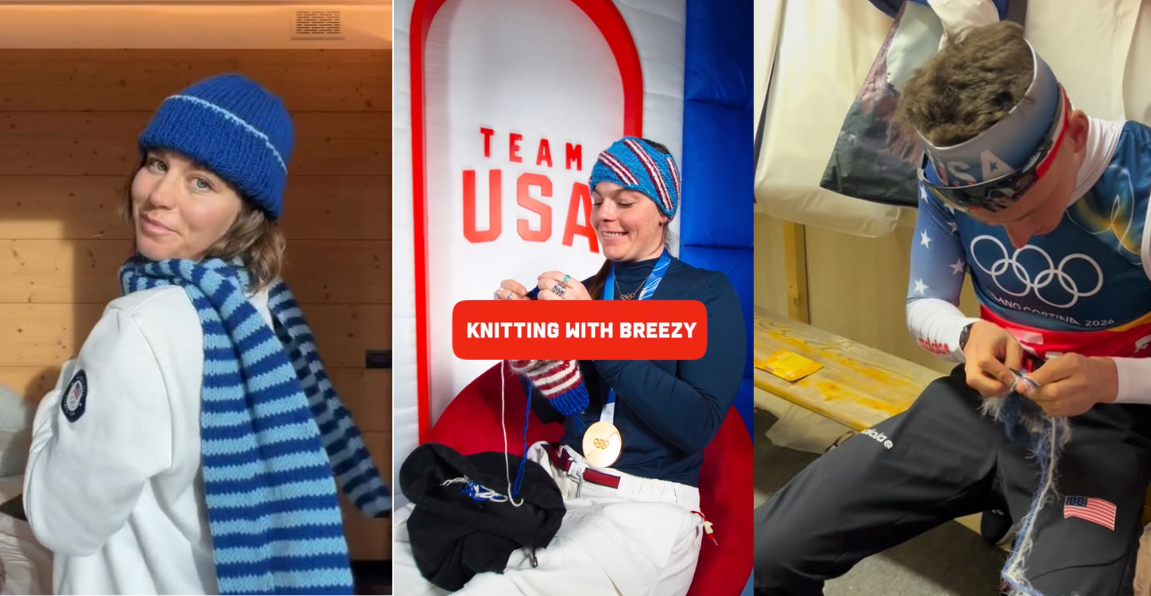
Knitting provides a calming, bilateral-stimulating activity useful during high-pressure events like the Winter Olympics. Diver Tom Daley popularized knitting between events at the Tokyo Olympics, inspiring other athletes to post works-in-progress on social media. Johnson knits headbands and hats in a loose, improvisational style, preferring self-drafted colorwork and stitch patterns rather than following patterns. The improvisational approach yields playful but sometimes uneven results, such as a wavy headband bottom alternating garter and knit stitch. Blocking soaks, shapes, and evens stitches, markedly improving finished appearance. Adding a 3–5 stitch i-cord would frame and stabilize complex colorwork.
"Knitting is the perfect activity to calm the body and soothe the mind during a high-pressure event like the Winter Olympics. Once you internalize your stitch pattern, you can just zone out and focus on how the yarn feels between your fingers, and for those EMDR girlies among us, knitting also counts as bilateral stimulation. Since diver Tom Daley went viral in 2021 for knitting between events at the Tokyo Olympics, he's become something of a knitbassador for the craft,"
"Johnson makes headbands and hats, according to this video. Her style is loose and somewhat improvisational; she doesn't follow patterns, preferring to self-draft colorwork and stitch patterns based on vibes. This is a fun way to knit! It does result in some wacky projects, though, such as this headband with a wavy bottom that seems to alternate between garter stitch and knit stitch between the color work."
"Johnson admitted that she doesn't block her work, which is hardly the worst sin a knitter can commit. Blocking is the final step in knitting a garment, when you soak the work in water and then lay it flat to shape the garment and make the stitches look nice and uniform. It's an extremely annoying step, but I'm sorry to say that it also makes a huge difference in how the final product turns out. Breezy, I really urge you to consider blocking your work!"
Read at Defector
Unable to calculate read time
Collection
[
|
...
]