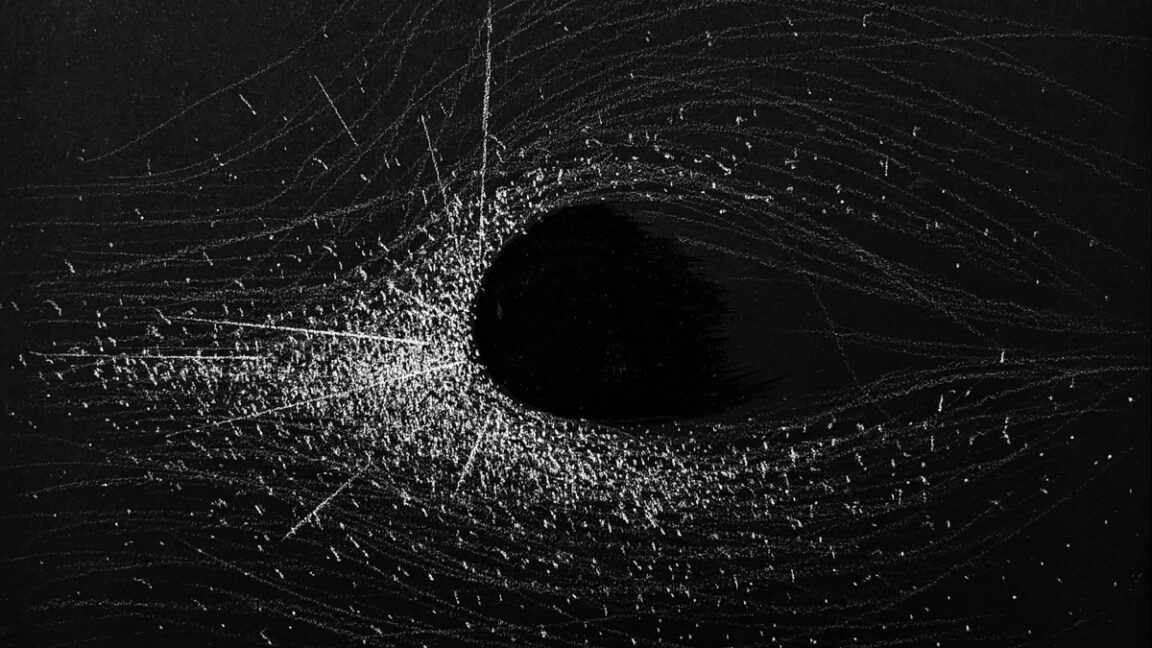
Dark-star imagery and literary precursors such as Poe's A Descent Into the Maelstrom and Harry Clarke's 1919 illustration acted as early analogies to black holes. Artistic work engages the concept across nearly every medium, including charcoal, pen-and-ink, oil and acrylic painting, murals, sculpture, traditional and digital photography, and immersive multimedia installations. Xu Bing's Gravitational Arena translates a Wittgenstein quote into a script resembling Chinese characters, applies gravity to form a singularity, and uses mirrors and vertical space to create a wormhole-like experience as an analogy for translation. Black holes serve as metaphors for extreme violence, atomic devastation, and the pull of depression.
"It's a mathematical construct at that point and it's very difficult to imagine a mathematical construct. Poe actually envisioned a dark star [elsewhere in his writings]."
"He takes a quote about language from Wittgenstein and translates it into his own script, the English alphabet written to resemble Chinese characters. Then he applies gravity to it and makes a singularity. [The installation] is several stories high and he covered the gallery floor with a mirror. So you walk upstairs and you see it's like a wormhole, which he turns into an analogy for translation."
"We see this violence in the works of artists like Cai Guo-Qiang and Takashi Murakami, who have used black holes to symbolize the brutality unleashed by the atomic bomb. The inescapable pull of a black hole is also a ready metaphor for depression in the work of artists such as Moonassi. Thus, on the one hand, the black hole provides artists with a symbol to express the devastations and anxieties of the modern world. On the other hand, however"
Read at Ars Technica
Unable to calculate read time
Collection
[
|
...
]