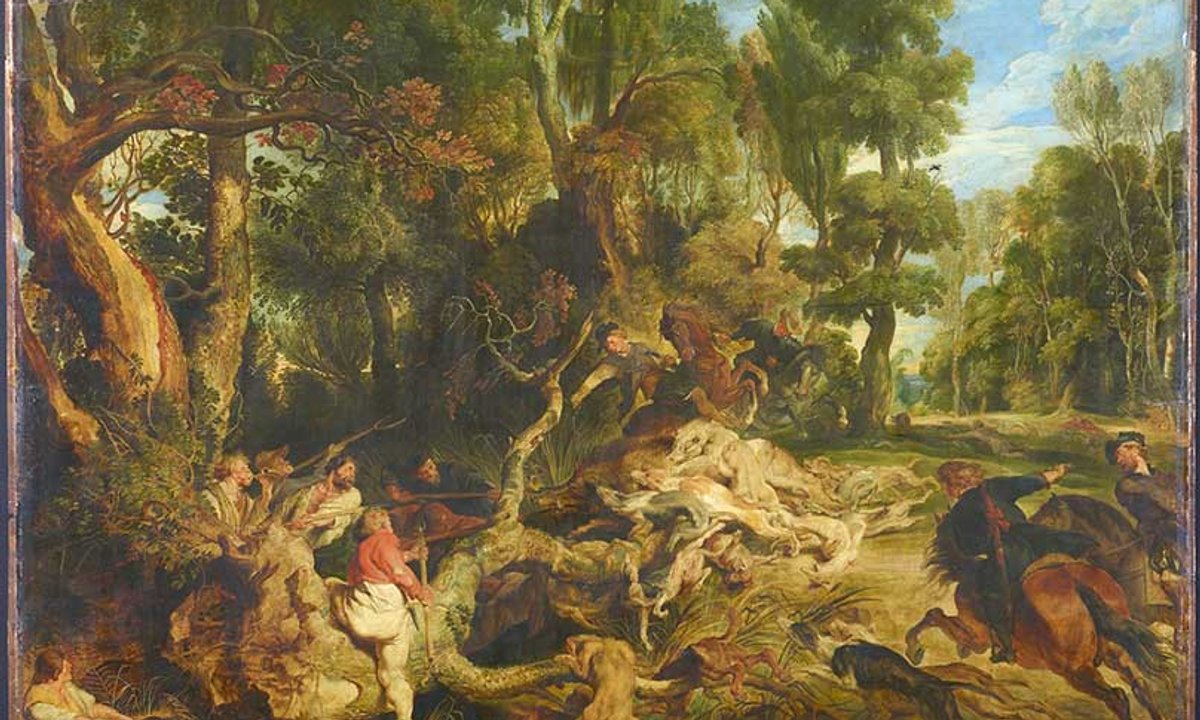
"The special significance of Dresden's The Boar Hunt is evident from the painting's previous owners: Peter Paul Rubens painted it for himself, without commission. Years later, he sold it to the Duke of Buckingham, and it later found its way into the Imperial collection in Prague before King August III acquired it for Dresden in 1749."
"During the creation process of the painting—presumably by Rubens and/or his workshop—a 24cm-wide board was subsequently added to the upper edge of the panel. During the course of the 19th century, several stabilisation measures were carried out by gluing battens across the wood grain. This soon led to problems, as cracks began to appear in the wooden panel."
"The true dynamism of its composition and original palette are obscured by a thick layer of discoloured 19th-century varnish. Conservators are currently cleaning the painting using ethanol, removing layers of varnish, surface dirt and old retouchings."
The Boar Hunt (1616-18) by Peter Paul Rubens, housed in Dresden's Gemäldegalerie Alte Meister, has been awarded the Tefaf Museum Restoration Fund for comprehensive restoration. Rubens painted this work for himself before it passed through notable collections including the Duke of Buckingham and the Imperial collection in Prague, eventually acquired by King August III for Dresden in 1749. Despite wartime relocation to Moscow and subsequent storage, the painting survived without serious damage. However, a thick layer of discolored 19th-century varnish obscures its original dynamism and palette. Conservation work addresses previous damaging interventions, including 19th-century battens glued across the wood grain that caused cracking. The wooden panel was thinned to 8mm, creating fragility. Conservators are cleaning the painting using ethanol to remove varnish, dirt, and old retouchings.
Read at The Art Newspaper - International art news and events
Unable to calculate read time
Collection
[
|
...
]