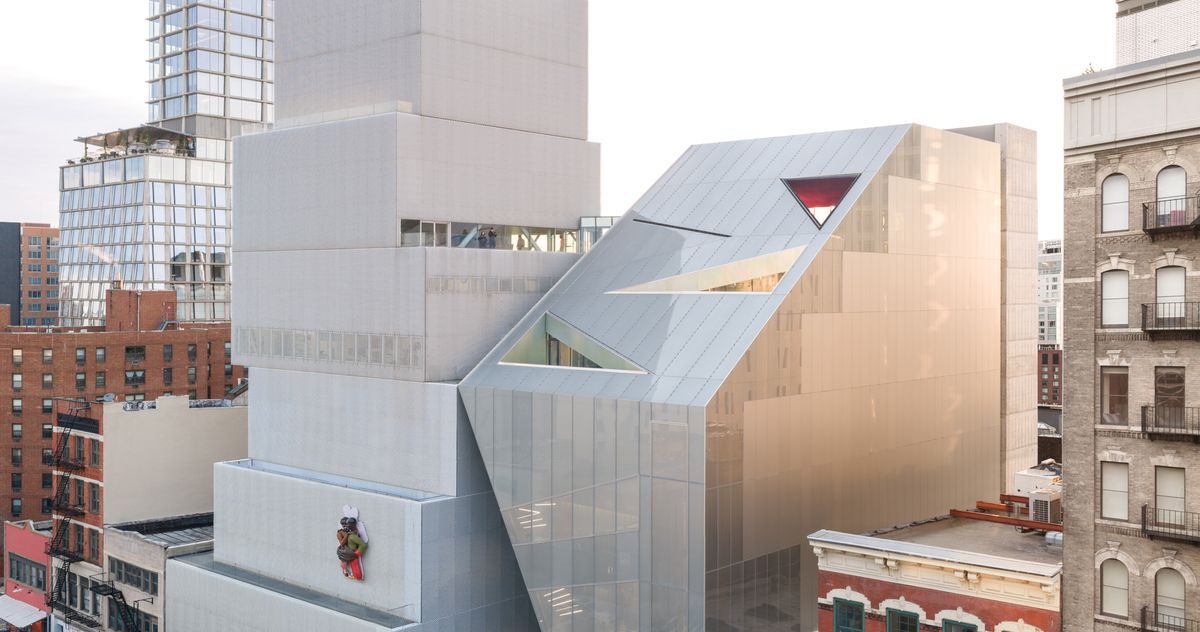
The New Museum on Bowery, originally designed by Sanaa architects in 2007, required expansion after less than a decade due to space constraints. Following a two-year closure, the museum reopens with a redesign by the Office for Metropolitan Architecture that honors the original building's distinctive characteristics while enabling growth. Sanaa's initial design featured stacked metal-clad boxes with ascending galleries that decreased in size and increased in ceiling height, creating dramatic verticality and an unconventional institutional experience. OMA's addition expands the museum horizontally by creating a connected neighboring structure with a crystalline street-facing facade and sturdy gallery spaces, allowing the original tower to maintain its architectural integrity while the new construction provides necessary capacity.
"The museum's first purpose-built home looked like a factory for manufacturing dreams, a tough and exuberant stack of metal-clad boxes so intent on artistic labor that it didn't even have the time to straighten itself out. Squeezed into a tight lot, it delighted in the drama of verticality. The galleries got smaller and the ceilings loftier as you climbed, so the 27-foot-high fourth-floor gallery felt grand but constrained, as if it had outgrown its container."
"A long, narrow stairway at the back connected galleries and passed a secret sculpture niche - a rejection of the usual grand lobbies and ceremonial staircases. It was, rather, the institutional equivalent of a speakeasy: Psst, come see some art."
"Now the museum has expanded sideways, growing a separate but connected neighbor. OMA's addition has a split personality: a crystal shard on the street, seamlessly sturdy galleries at the back. As you walk east down Prince Street where it dead-ends at Bowery, the new structure appears to be leaning against the off-kilter tower."
Read at Curbed
Unable to calculate read time
Collection
[
|
...
]