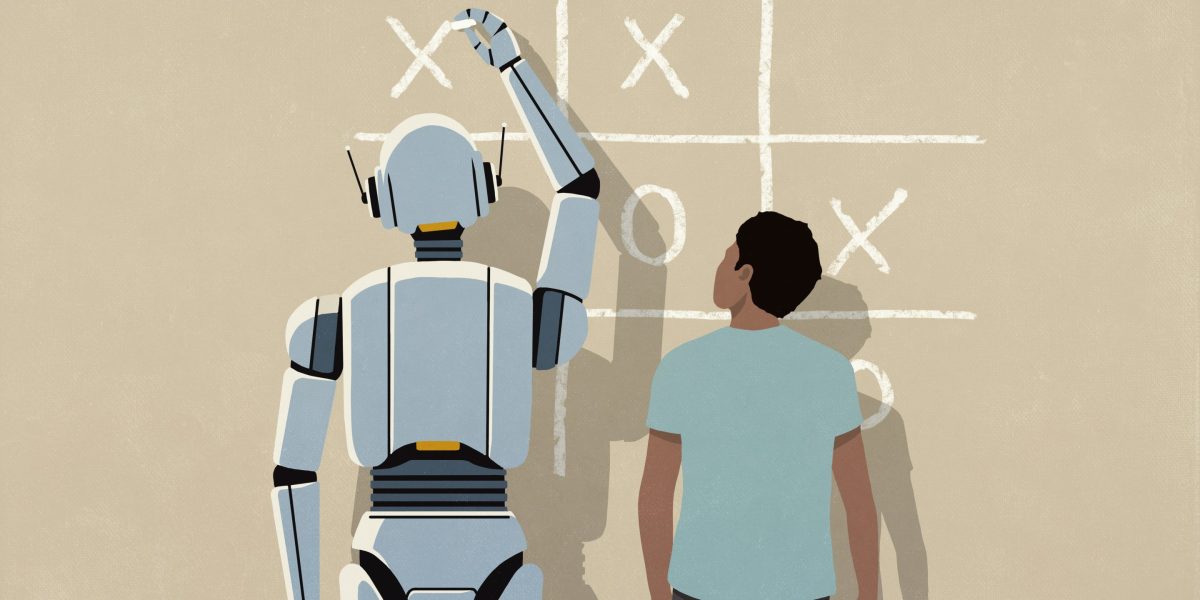
"For decades, technologies have largely been built as tools, extensions of human intent and control that have helped us lift, calculate, store, move, and much more. But those tools, even the most revolutionary ones, have always waited for us to 'use' them, assisting us in doing the work-whether manufacturing a car, sending an email, or dynamically managing inventory-rather than doing it on their own."
"With recent advances in AI, however, that underlying logic is shifting. "For the very first time, technology is now able to do work," Nvidia CEO Jensen Huang recently observed. "[For example], inside every robotaxi is an invisible AI chauffeur. That chauffeur is doing the work; the tool it uses is the car." This idea captures the transition underway today. AI is no longer just an instrument for human use:"
Technologies were traditionally built as tools that extend human intent and enable tasks such as lifting, calculating, storing, and moving. Recent AI advances enable technology to perform work autonomously rather than merely assisting humans. Agentic AI can plan, act, adapt, learn, coordinate across workflows, make decisions, and execute tasks, blurring the line between machine and teammate. Businesses will face synthetic, distributed, and continuously evolving portions of their workforce as agents take on operational roles. Leaders must redesign work, decision rights, and organizational structures to integrate agentic capabilities. Organizational redesign will determine whether agentic AI becomes a source of strategic differentiation.
Read at Fortune
Unable to calculate read time
Collection
[
|
...
]