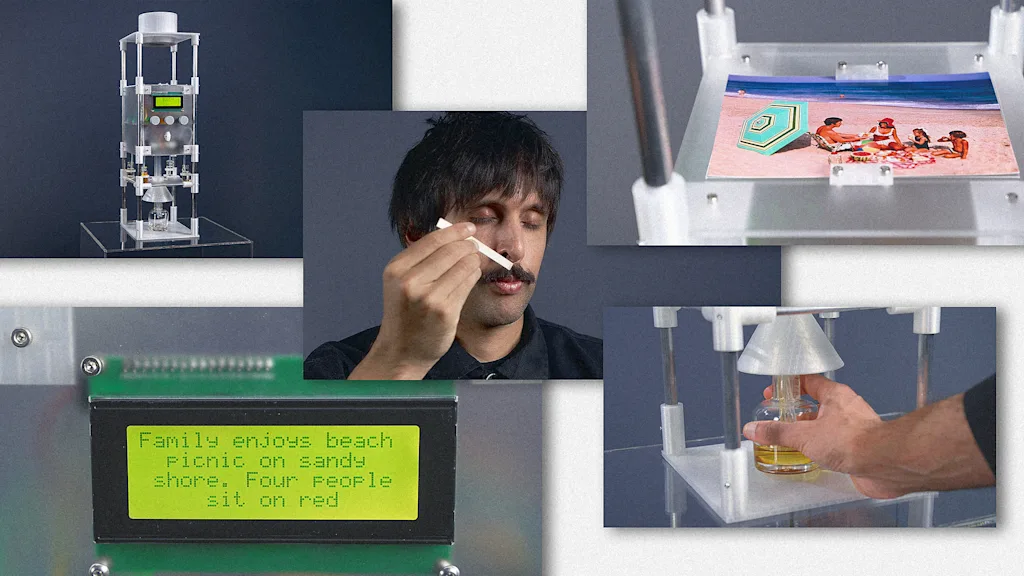
"One scientist at MIT, Cyrus Clarke, is working to do just that. Alongside a team of fellow researchers, Clarke has developed a physical machine called the Anemoia Device, which uses a generative AI model to analyze an archival photograph, describe it in a short sentence, and, following the user's own inputs, convert that description into a unique fragrance. The word "anemoia" was coined by author John Koenig and included in his 2021 book, The Dictionary of Obscure Sorrows."
"According to a paper published by the team, the device explores the concept of "extended memory," or the idea that, in the digital age, memory is increasingly stored and accessed through external media, like digital archives. Studies have already shown that memory can be formed vicariously-like when a second-hand account, perhaps from a parent, shapes one's own memories-but the Anemoia Device is a delightfully physical, interactive experiment into how AI might allow users to experience a memory of a past they never actually lived."
"The Anemoia Device looks like something that one might find in the medical bay of a retro sci-fi spaceship. It's a slim, metal-and-plastic contraption accented with a singular neon green screen and a simple array of three physical dials. At the bottom, a glass beaker waits to catch the final fragrance. To start, a user inserts a photograph into the device. A built-in vision-language model (VLM) analyzes the image and generates an initial caption"
The Anemoia Device analyzes archival photographs with a built-in vision-language model to generate a short caption and translate that caption, combined with user inputs, into a bespoke fragrance. The device uses a generative AI pipeline to map visual and descriptive elements to odorant components and dispenses the resulting scent into a glass beaker. The concept of anemoia frames the goal: to evoke nostalgia for times or places not personally experienced. The project frames memory as increasingly externalized in digital archives and treats scent as a medium for extended, vicarious memory formation facilitated by interactive, physical technology.
Read at Fast Company
Unable to calculate read time
Collection
[
|
...
]