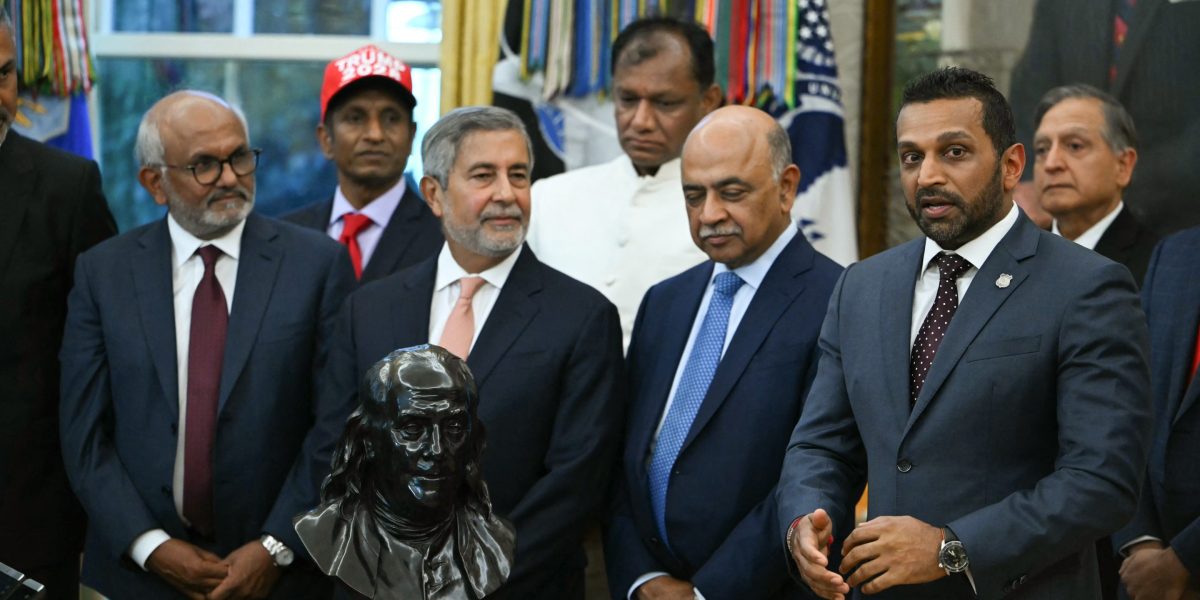
"“The balance between too many regulations, it's terrible; too few, we may not love the outcome, so we got to find the Goldilocks middle.” Krishna extended his warning to the international landscape: “If it turns into a bloated bureaucracy, that would not be so good for us to win the AI race.”"
"The balance Krishna identifies extends well beyond federal policy. It runs downward into a state-by-state patchwork of legislation now reshaping how American companies build and deploy AI, and upward into a global contest where technological competitiveness underwrites both economic prominence and national security. No clear path forward has emerged at any level. In our conversations with CEOs and political leaders, that lack of clarity is the common refrain."
"In the past nine months, the United States has produced more AI legislation than in the prior decade, and on three different theories of what AI policy is supposed to do. California's SB 53 focuses on transparency from frontier developers. New York's Responsible AI Safety and Education (RAISE) Act mandates stricter incident reporting and a new oversight office inside the Department of Financial Services. The Texas Responsible Artificial Intelligence Governance Act ( TRAIGA) prohibits specific intentional misuses and establishes a 36-month regulatory sandbox. Connecticut joined two weeks ago, when both chambers passed Senate Bill 5 (SB5) by lopsided margins after years of failed attempts."
"Meanwhile, federal policy has lurched in opposite directions. President Trump's December 11 executive order directed the Department of Justice to challenge state AI laws and conditioned broadband funding on alignment with a “minimally burdensome” national standard. The 2026 National Defense Authorization Act (NDAA), signed the day before, excluded preemption language"
AI policy faces a central challenge: too much regulation harms progress, while too little may produce undesirable outcomes. The problem extends from federal rules to a state-by-state patchwork that affects how companies build and deploy AI. International competition adds pressure because technological leadership supports economic strength and national security. No clear path forward has emerged, and leaders and CEOs report persistent uncertainty. In the past nine months, the United States has produced more AI legislation than in the prior decade, with different approaches. California emphasizes transparency for frontier developers, New York requires stricter incident reporting and oversight, and Texas creates a regulatory sandbox while limiting certain intentional misuses. Federal policy has shifted in opposing directions, including efforts to challenge state laws and condition funding on a minimally burdensome national standard, alongside changes in defense legislation.
Read at Fortune
Unable to calculate read time
Collection
[
|
...
]