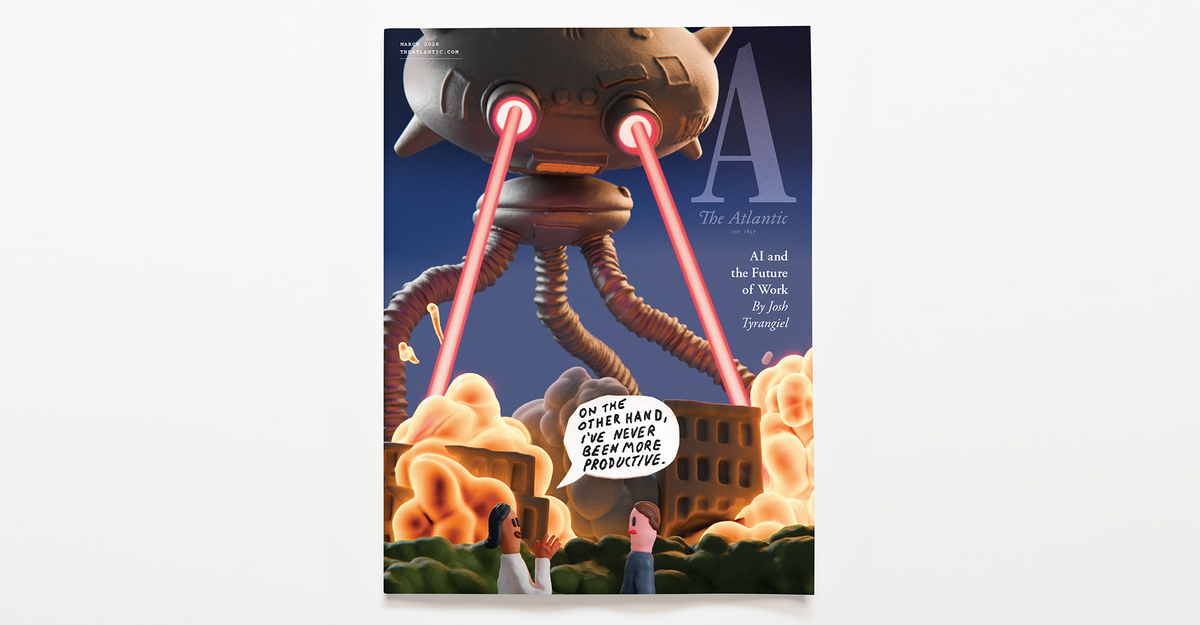
"He writes that an exact prediction is hard to pin down: It's perhaps less immediate than many of the technology's biggest boosters might hope, but AI still represents a development that will fundamentally alter our society, and governments ought to be thinking seriously about how to protect their constituents from the inevitable shock waves. Trying to measure the impact of AI with today's data can feel like driving while looking only in the rearview mirror--"plenty dangerous if the road stays straight, catastrophic if it doesn't.""
"AI is already transforming work, one delegated task at a time. If the transformation unfolds slowly enough and the economy adjusts quickly enough, the economists may be right: We'll be fine. Or better. But if AI triggers a rapid reorganization of work-compressing years of change into months, affecting roughly 40 percent of jobs worldwide, as the International Monetary Fund projects-the consequences will not stop at the economy. They will test political institutions that have already shown how brittle they can be."
Central bankers, labor economists, AI executives, union leaders, Cabinet secretaries, and populist political figures express consensus that societies are unprepared and leadership is lacking for AI-driven labor change. An exact timetable for displacement is uncertain: AI may progress gradually, allowing economic adjustment, or it may trigger a rapid reorganization compressing years of change into months. Rapid change could affect roughly 40 percent of jobs worldwide and produce cascading economic effects—missed loan payments, defaults, shrinking demand—and strain political institutions. Governments should plan policies to protect workers and stabilize financial and political systems against potential shock waves.
Read at The Atlantic
Unable to calculate read time
Collection
[
|
...
]