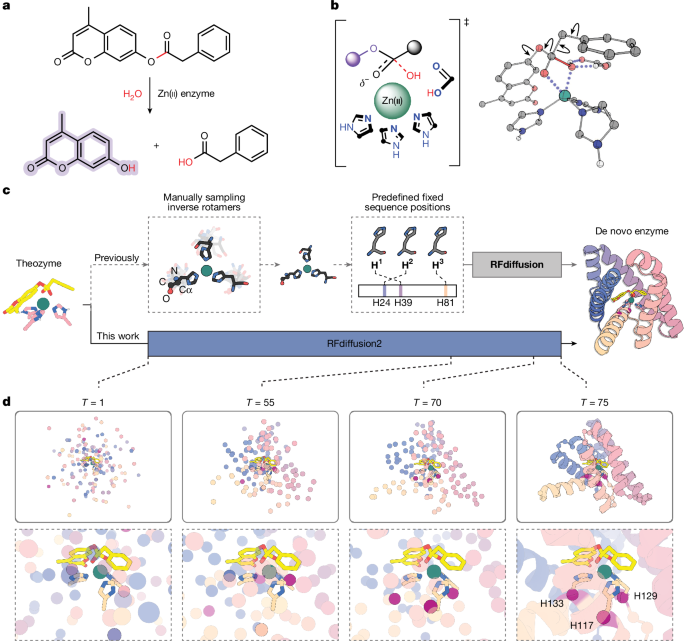
"Metallohydrolases catalyse some of the most difficult hydrolysis reactions in biology by using their bound metal ions to activate a water molecule positioned adjacent to the substrate bond to be cleaved16,17,18. Engineering new metallohydrolases is currently of considerable interest for degrading human-generated environmental pollutants, for which there has not been sufficient time for efficient hydrolytic enzymes to evolve19,20,21."
"We reasoned that a generative artificial intelligence design method that only required the specification of side-chain functional group positions around a reaction transition state, and was capable of sampling over all possible sequence positions and conformations of these residues, could more readily satisfy complex catalytic constraints14,15,28,29. We set out to develop such an approach, and used it to design new metallohydrolases starting from a quantum chemistry-generated active site description with a bound metal cofactor."
Metallohydrolases catalyse challenging hydrolysis reactions by using bound metal ions to activate a water molecule adjacent to the substrate bond. Engineering new metallohydrolases targets degradation of human-generated environmental pollutants that lack evolved enzymatic solutions. Protein engineering can expand substrate scope but often depends on initial promiscuous activity. De novo enzyme design has produced metallohydrolases with limited activity and efficiency that frequently require extensive directed evolution. Accurate positioning of catalytic residues, metals, and substrates in optimal geometries is essential. A generative AI approach that specifies side-chain functional group positions around a reaction transition state while sampling sequence positions and conformations can better satisfy complex catalytic constraints. RFdiffusion2 was developed to enable sequence-position and side-chain rotamer-agnostic design using quantum chemistry-derived active-site descriptions with bound metal cofactors.
Read at Nature
Unable to calculate read time
Collection
[
|
...
]