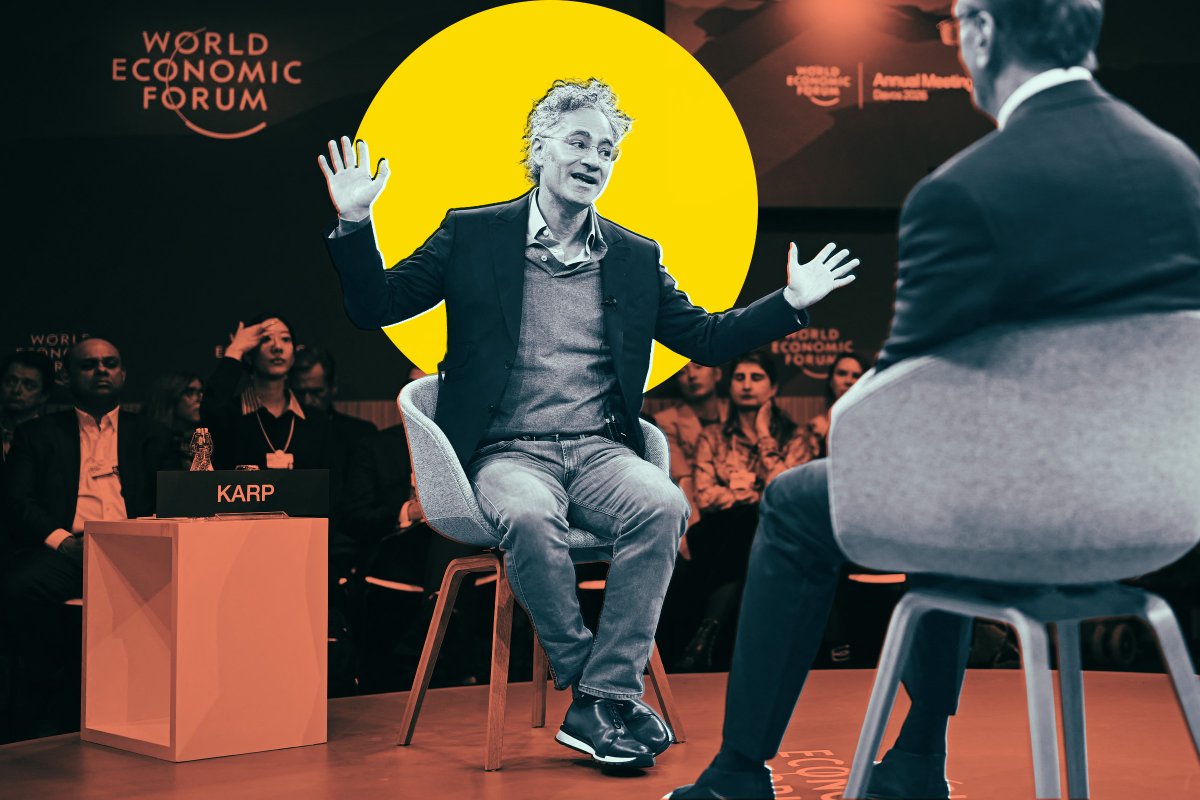
"Wondering what your career looks like in our increasingly uncertain, AI-powered future? According to Palantir CEO Alex Karp, it's going to involve less of the comfortable office work to which most people aspire, a more old fashioned gruntwork with your hands. Speaking at the World Economic Forum yesterday, Karp insisted that the future of work is vocational - not just for those already in manufacturing and the skilled trades, but for the majority of humanity. In the age of AI, Karp told attendees at a forum, a strong formal education in any of the humanities will soon spell certain doom."
""You went to an elite school, and you studied philosophy; hopefully you have some other skill," he warned, adding that AI "will destroy humanities jobs." Karp, who himself holds humanities degrees from the elite liberal arts institutions of Haverford College and Stanford Law, will presumably be alright. With a net worth of $15.5 billion - well within the top 0.1 percent of global wealth owners - the Palantir CEO has enough money and power to live like a feudal lord (and that's before AI even takes over.) The rest of us, he indicates, will be stuck on the assembly line, building whatever the tech companies require."
The future of work will become predominantly vocational, shifting many people away from office-based intellectual labor toward hands-on manufacturing and technical roles. A strong formal education in the humanities will lose economic value and lead to job displacement as AI automates cognitive tasks. Vocational technicians involved in manufacturing, such as battery assembly, will become highly valuable and harder to replace. Wealth and power will concentrate with tech owners, who will remain insulated from labor-market dislocation. The global economy will continue to rely on manufacturing and skilled trades, but the rise of AI will reshape occupational hierarchies and deepen economic inequality.
Read at Futurism
Unable to calculate read time
Collection
[
|
...
]