"Technology is both the remedy and the poison," artist Cao Fei quotes Bernard Stiegler, emphasizing the complex relationship between technological advancements and their impact on human practices.
Tom Prochaska distinguished himself in many mediums: He was a masterful printmaker, an intuitive painter, a builder of papier-mâché figures, a creator of fused glass panels, and graphite-on-paper drawings.
ArtsLink is envisioned as an essential community resource that aims to increase visibility, spur audience engagement, and strengthen the local arts and culture ecosystem.
The Olympus Perspective Playground operates as a fully built system, where walls, lighting rigs, circulation paths, and signage are developed together with each installation, creating a continuous spatial script.
Much of Instagram's video content is organized around transformation-the virtual magic of the before-and-after and clips that show cause and effect. A person makes pasta from scratch in 20 seconds via edits that compress time-intensive labor.
In both places, there was a sense of energy building that was not yet fully visible. The experiences made me realize that, while sales totals and fair brands can serve as benchmarks of centrality, slower, structural transformations are taking place throughout Asia that merit closer attention.
"The idea is that intention is not the whole story," says Selene Yap, a co-curator of the Biennale. "Systems can generate a certain kind of afterlife, and there are side effects." While the waterfall impresses, it also has consequences, she adds. The work uncovers how Singapore imports hydropower through transnational infrastructure, including the Vajiralongkorn Dam, whose construction has displaced Thailand's indigenous Karen hill tribe, forcing many to live in floating homes on the reservoir.
This year's Art SG, which closed last month, featured an intriguing debut: South Asian Insights, a modest pavilion dedicated to contemporary art from the region. Part of the TVS Initiative for Indian and South Asian Contemporary Art, it was backed by India's TVS Motor Company, one of the world's largest two-wheel manufacturers, which has its global headquarters in Singapore. Eight galleries-five from India-were each given a wall to showcase art.
The Thai artist Pinaree Sanpitak began exploring female breasts in her work shortly after the birth of her son in 1994, when she began breastfeeding. Reflecting on her experience as a mother, the breast became a metaphor for herself as well as a broader celebration of womanhood. In 2001 Sanpitak began to draw parallels between the breast and Buddhist stupas-dome-shaped sites of veneration, and began her Breast Stupa series, combining the sacred with the sensuous.
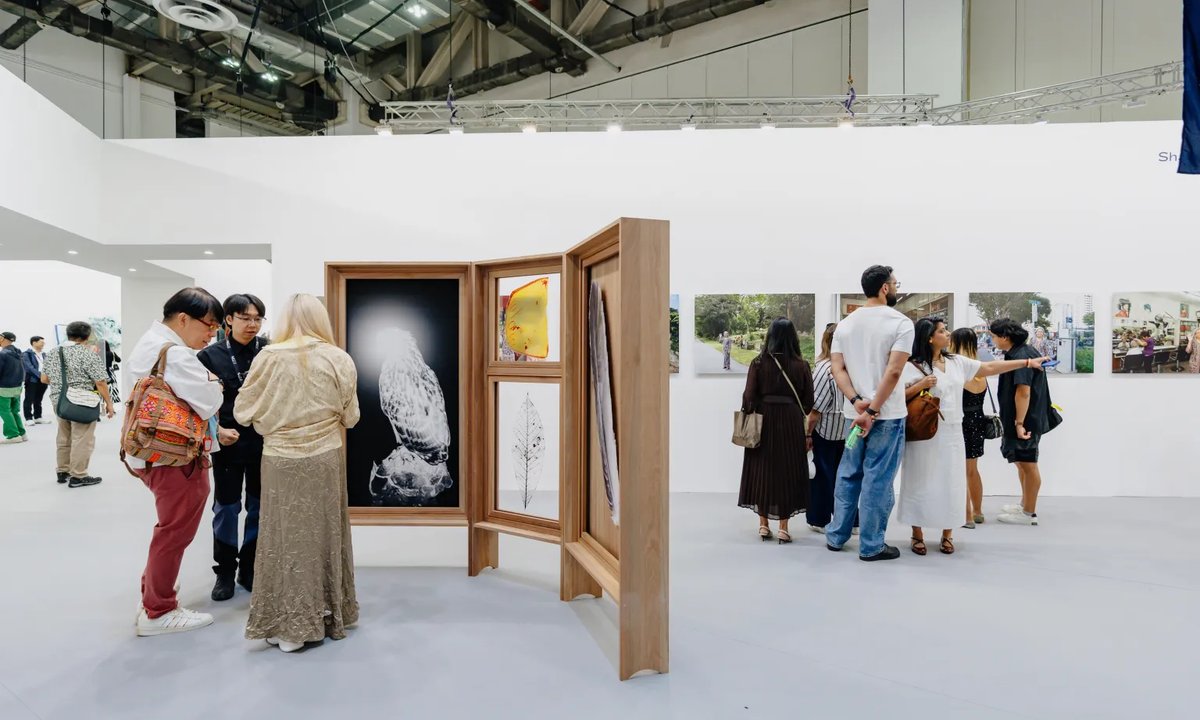
Art SG wrapped its fourth edition on Sunday, reporting 43,000 visitors during its four-day run, up from last year's 41,000. The S$250,000 ($197,000) SAM Art SG Fund, backed by patrons Carmen Yixuan Li, Pure Yichun Chen, and Pierre Lorinet, acquired works by Mona Hatoum (from White Cube) and Lotus L. Kang (from Commonwealth and Council) for Singapore Art Museum 's permanent collection. Some dealers said they made satisfactory sales, mostly for five or six digits.