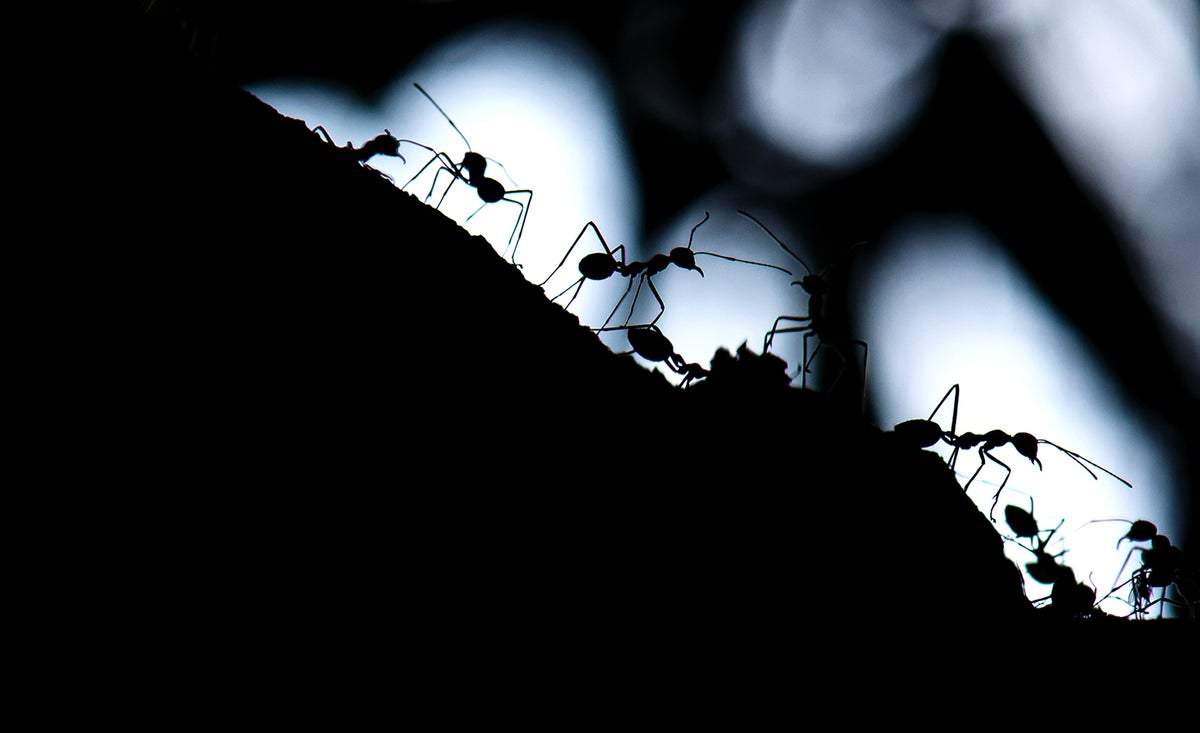
"When the sun sets, millions of nocturnal ants awaken ready to eat. Some species forage all night, traveling from nest to food source and back again, often following trails they mark with scent. Scientists assumed bull ants, which don't rely primarily on scent navigation, had to wake up before dark and use the day's last light to find their way to sustenance. But a new study of one bull ant species shows the insects continue to navigate when the sun goes down using an innate lunar compass."
"Just as diurnal ants follow the relatively steady movement of the sun, the bull ant species has adapted to the orbiting moon's constant changes, according to research published in Current Biology. The ants use what the researchers call time compensation: they keep track of how much time has passed since they left the nest to gauge where the moon should be in the night sky, much like early human navigators used the North Star."
"These ants use a lot of different cues at the same time, and that helps them in case one cue becomes unreliable. The researchers captured the insects en route to their usual feeding areas and put a subset into darkened boxes that lacked any environmental cues about time passing. (They put others in transparent boxes.) After several hours the scientists released the ants in a new location and watched them try to find their way to food."
"When held in darkness for long enough that the moon moved significantly, the ants veered off course, suggesting its position was their main cue. This is just a little bonkers, says Rodolfo da Silva Probs"
Millions of nocturnal ants become active at sunset to forage. Bull ants were previously thought to need pre-darkness light to navigate, but a study of one bull ant species shows continued navigation after sunset. The ants use an innate lunar compass and time compensation, tracking elapsed time since leaving the nest to estimate the moon’s position in the night sky. This approach parallels how diurnal ants use the sun’s movement. The ants rely on multiple cues simultaneously, improving reliability when any single cue becomes unreliable. Experiments captured ants traveling to feeding areas and tested them in darkened boxes lacking time cues, then released them at new locations to observe their search behavior.
Read at www.scientificamerican.com
Unable to calculate read time
Collection
[
|
...
]